JEAN-MARIE TJIBAOU: Legacy to Kanaky - New Caledonia
When I was in Papua New Guinea at the University in the 1980s, I was given the opportunity to translate from French a speech at a Pacific forum for:
Jean-Marie Tjibaou (1936-1989):
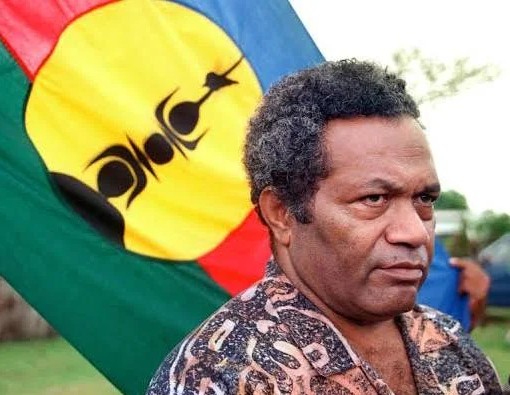
- Charismatic independence leader for New Caledonia - Ex- priest, educated politician whose arguments used logic * - Fought for awareness of Kanak identity and independence - President of FLNKS, the party overseeing Kanak independence - Designed the Kanak flag, recently seen jointly with the tricolore - Devised and signed the tripartite Matignon Accords (Paris 1988) - Independence announced for 1998. Independentists killed - Was assassinated by an extremist of his own side in 1989.
Jean-Marie Tjibaou (son, Emmanuel, currently a member of the French National Assembly for New Caledonia) coined the phrase “PACIFIC MY NUHOM” [Pacific, My New Home], to show the links between his country and the Melanesian countries of the Pacific (Papua New Guinea, Solomon Islands and Vanuatu). He spoke with passion, persuasion of the similarities in their histories, languages, and customs.
Further he was also able to resolve two demanding situations:
1. The PNG leadership was unable to support him because Bernard Narakobi who held a philosophy of Melanesia did not come to power in PNG. Yet thanks to the Non-Aligned Movement of newly independent Vanuatu, Tjibaou was supported at the United Nations Assembly in 1986 with a vote confirming: ‘the inalienable right of the people of New Caledonia to self-determination’
2. François Mitterand (of the Socialist Party) became President but was not able to support him early on. Yet Tjibaou succeeded to negotiate with his Prime Minister Michel Rocard ‘Les Accords de Matignon’ in 1988 when he led the pro-independence delegation while Jacques Lafleur, a ‘Caldoche’ or New Caledonian of European origin led an anti-independence delegation. They shook hands. The photo of the ‘handshake’ shocked some of his younger extremists (this may have led to his assassination).
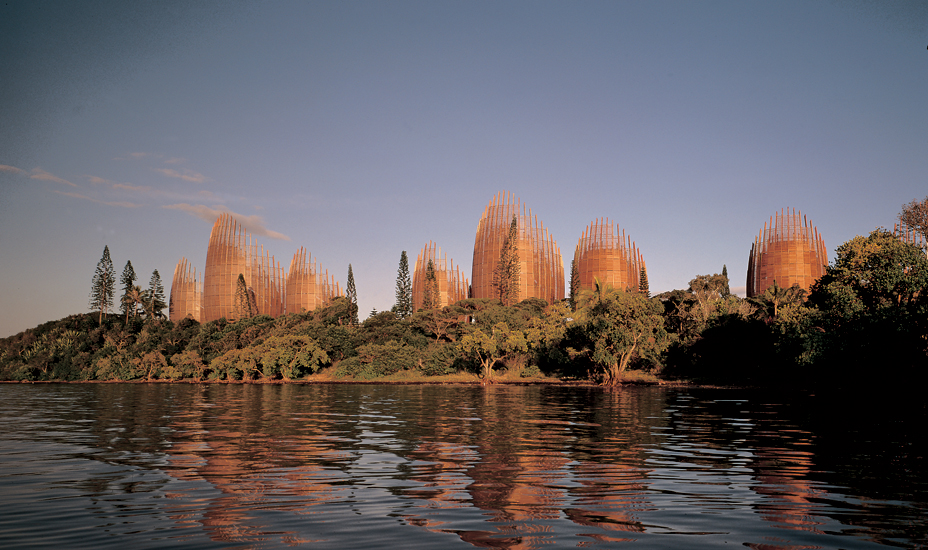
Jean-Marie Tjibaou’s name was given to a newly designed Cultural Centre (see above) inaugurated in Noumea (1998) to add value to the Kanak Culture, a project he had initiated at the time of the Matignon Accords. It is an Agency for the development of the Kanak Culture and is led by his widow Marie-Claude Tjibaou.
Further the two men involved with Rocard in the handshake were awarded in 2010 (this was posthumous for J M Tjibaou) ‘La Colombe de la Paix,’ an annual prize via Germany supported by UNESCO.
*Quote: We want the right to Independence in our country. It is not more racist than to speak of having French citizenship.
JEAN-MARIE TJIBAOU: sonhéritage pour Kanaky-Nouvelle Calédonie
Lorsque j’étais en Papouasie Nouvelle Guinée, à l’université, dans les années 1980, j’ai eu l’occasion extraordinaire de traduire à un forum sur le Pacifique le discours de :
Jean-Marie Tjibaou (1936-1989)
- leader indépendantiste charismatique de la Nouvelle-Calédonie - prêtre défroqué, politicien éduqué, de parole raisonnée* - lutta pour faire reconnaitre : identité kanak et indépendance. - président du FLNKS, parti pour l'Indépendance - dessina le drapeau pour 'Kanaky', récemment joint au tricolore - négocia (Paris) en tripartie, signa les Accords de Matignon 1988 - prévu l’Independence pour 1998, mais Indépendantistes tués - a été assassiné par un extrémiste de son propre camp en 1989.
Jean-Marie Tjibaou (dont le fils, Emmanuel, représente 'Kanaky' en ce moment comme membre de l’Assemblée Nationale en France) a inventé une phrase inclusive: ‘PACIFIC MY NUHOM’ [Pacific My New Home]. Il a démontré les liens de son pays avec les pays Mélanésiens du Pacifique ( Papouasie Nouvelle Guinée, Les Iles Solomon et Vanuatu) et a parlé avec passion et logique des similitudes d’histoire, de langues et coutumes.
Plus tard il réussira à résoudre deux autres situations difficiles.
1 Les leaders de PNG ne pouvaient l’aider car Bernard Narakobi malgré une philosophie de Mélanésie n’a pas pris le pouvoir. Mais Tjibaou réussit à se joindre au ‘Mouvement Non-aligné’ de Vanuatu, nouvellement indépendant et de faire agréer et voter aux Nations Unies en 1986 : ‘le droit inaliénable des peuples de la Nouvelle Calédonie à l’auto-détermination’.
2 François Mitterand du parti Socialiste devint President en 1981 mais ne l’a pas soutenu dès le début. Tjibaou réussit néanmoins à négocier grâce au Premier Ministre Rocard les Accords de Matignon en 1988 : il mena une délégation indépendantiste jointe avec la délégation anti-indépendantiste du député NC Jacques Lafleur. Ils se sont serrés la main et la photo de cette ‘poignée de main’ a choqué des jeunes extrémistes de son mouvement (ce qui a pu être la cause de son assassinat).
Jean-Marie Tjibaou avait donné son nom au Centre Culturel (ci- dessus) inauguré en 1998 à Nouméa pour valoriser la culture kanake qu'il ’avait projeté au moment des Accords de Matignon. Cette Agence pour le Développement de la Culture Kanak est tenue par sa veuve Marie-Claude Tjibaou.
Plus récemment les deux hommes de la ‘poignée de main’ ont reçu en 2010 (à titre posthume pour J M Tjibaou) la ‘Colombe de la Paix’, prix annuel de l'Allemagne soutenue par l'UNESCO.
* Citation Nous voulons le droit d’avoir l’Indépendance de notre pays. Ce n’est pas plus raciste que de parler d’une citoyenneté Française.
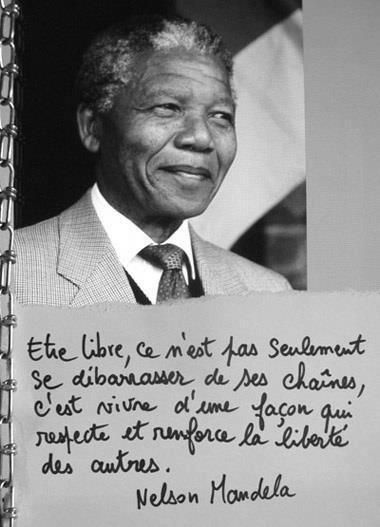
                    “For to be free is not merely to cast off one's chains, but to live
                          in a way that respects and reinforces others' freedom.”
                         Nelson Mandela, Long Walk to Freedom, 1994.
                                                  [Pinterest Pic]
Looking for Freedom: Embracing change and identity


Freedom came to me
the day I moved from home,
my folk living in a gendarmerie.

I withdrew from France,
I left, and rejected
all my parents had intended for me.

Straight across to England I faced its frozen winds.
With luck I happened to bump into a young man
who wanted to travel, so we went overseas.

To Africa where Zambia became Independent.
Years of pleasure in the teaching
of the young and motivated learners!

Following old traditions that seemed new to me,
I adapted, out in the bush, used a hot water bottle
for my newborn who needed an incubator.

Then in the Pacific, Papua New Guinea
also gained its Independence. My family surrounded
by varied Indigenous folks who spoke multiple languages.

Travels and friendships were soon to end.
Integrated I’d thought, but we were to migrate.
Australia. How would it modernise our lifestyle?

There, ‘shock and awe’, we glared. Who’d fill the gap,
to bring in the Aborigines, who possessed less resources
than our friends in Africa or the Pacific?

I’d need to free myself again. I didn’t want to become
more French than before. Still I remained wondering
how long it’d take for Aboriginal culture
to become ‘respected and reinforced’, here.


Liberté : Accueillir un renouveau d’identité


La liberté, je l’ai cherchée.
Je décidai, un jour, de quitter la maison,
mon père gendarme, je partis sans les clés.

J’abandonnai la France, rejetai mon passé
tout ce que mes parents pour moi auraient voulu.
Je laissai ma famille et traversai la Manche.

Les vents Anglo-Saxons me refroidirent.
Enfin, je rencontrai un jeune homme qui voulait
rallumer sa vie en voyageant à l’étranger.

En Afrique, la Zambie prit son indépendance.
Des années de plaisir à enseigner
des étudiants jeunes et très motivés !

Des traditions anciennes, quoique nouvelles pour moi.
Je m’adaptai. Un jour en pleine brousse, mon bébé
n’eut pour couveuse qu’une simple bouillotte toute chaude.

Plus tard dans le Pacifique, La Papouasie Nouvelle Guinée
eut, elle aussi, son Indépendance. Ma famille fut alors entourée
de personnes Indigènes dont les langues offraient multiples variétés.

Soudain les voyages et les rencontres amicales se terminèrent,
je me croyais intégrée mais l’heure de notre rapatriement arriva.
Emigrants en Australie, aurons-nous une vie plus modernisée ?

‘Le choc et l’admiration’ deviennent ‘Rapide Dominance’.
Comment garnir accès pour les Aborigènes
qui avaient moins de ressources que nos amis
d’Afrique ou du Pacifique ?

Aurais-je donc le temps de me relibérer
Ou deviendrais-je plus Française qu’avant ?
Mais combien de temps pour que la culture
Aborigène soit ‘respectée et renforcée’, ici ?



 Yayi's Paroles
You must be logged in to post a comment.