Roebourne (Ieramugadu)-my favourite small town in Australia (Bilingual)

Featured
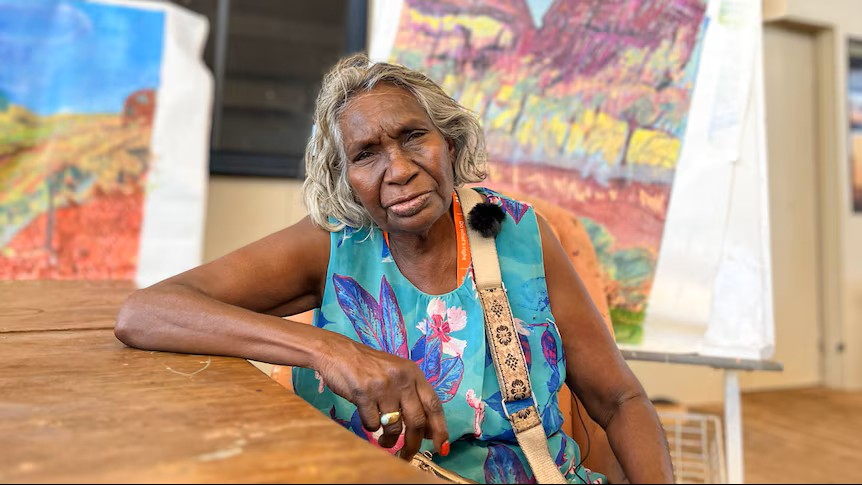
Wendy Hubert – courtesy ABC News

Why Roebourne is my favourite small town in Australia

In March 2026 Yindjibarndi Elder Wendy Hubert and Juluwarlu Art Cooperation 
travelled 5,000 km by road from Roebourne to Sydney as guests of the Sydney Biennale.
Links:
- Indigenous artworks taken on 5,000km road trip from the Pilbara to Biennale of Sydney - ABC News
- Wendy Hubert | 25th Biennale | Rememory | SBS On Demand


Roebourne [Ieramugadu, in Ngarluma; population 981-2016 census ],
is located within the City of Karratha at 1,563 from Perth (West Australia)
From 1930-1950 it was a non-Indigenous administrative centre.
The Yindjibarndi, Kuruma, Yaburrara, Marthudunera, Banjima, and
Kariyarra people were gathered to camps and reserves with controls and
curfews placed on Aboriginal people’s movements to, from, and within
the town. Later, iron-ore mining enterprises constructed company towns
and moved people from the crowded surrounds into Roebourne in the
1960s.

Exile and the Kingdom www.sbs.com.au/ondemand/tv-series/exile-and-the-kingdom
an award-winning documentary captured the spirit of the town, narrated by
a late elder with the Yindjibarndi, Ngarluma, Banyjima and Kurrama people
of Roebourne. It recounts the experiences of the Aboriginal community
from pre-colonial times to the 1990s.

Community centres in Roebourne include a Health Centre, an Aged
people’s home, a library, a primary and secondary school. It holds cultural
centres like the Ngarluma Yindjibarndi Foundation Ltd, and the media
station https://www.ngaardamedia.com.au/ngaarda-radio. Preserving the
Yindjibarndi history & culture Juluwarlu https://juluwarlu.com.au/ documents
the ngurra (the land) with the help of artist like Yindjibarndi Elder Wendy
Hubert while teacher, linguist and artist, Allery Sandy, runs the art centre
‘Yinjaa-Barni (Working Together)’ (www.yinjaa-barni.com.au)

Wanthiwa’ is the Yindjibarndi ‘Welcome’ word I heard when I walked
down the streets in Roebourne. I met the ‘strong’ women and men that
made the town real, similar to when I lived in France and people always
greeted each other. I enjoyed walking alongside families sitting on the
verandah. The town residents also walked from one house to the other
to consult with one another, as against those who walk for exercise,
which most of us do in Australia, without talking to anyone. I have fond
memories of families sitting on the verandah. This contrasted with life
in Karratha where I lived, driving from one spot to the next, usually in
large 4 x 4 vehicles and only seemed to speak to people in shops or
offices. I worked as the Roebourne Prison Education Officer for three
years where a majority of Indigenous people spent spells of months or
years as minimum priority prisoners, often for fine overloads or
breaching a driving licence. There I ran the Education Centre
where prisoners used their time catch up with their education which
had been interrupted.

Community gatherings I later worked for the local shire and organised
exchanges between the Indigenous community and the multicultural
residents of the local towns. We shared picnics with a taste of kangaroo
tails cooked in the ashes. A gathering is held in early July for all the older
Aboriginal people to celebrate their birthdays, given that their birthdates
were never registered.

In Australia’s massive country, this compact town will always have a place
in my heart.
Roebourne , ma petite ville préférée en Australie
En mars 2026, Wendy Hubert, aînée Yindjibarndi, et Juluwarlu Art
Coopération ont parcouru 5 000 km par la route, de Roebourne à
Sydney, en tant qu’invités de la Biennale de Sydney. Links below:
Indigenous artworks taken on 5,000km road trip from the Pilbara to Biennale of Sydney - ABC News
Wendy Hubert | 25th Biennale | Rememory | SBS On Demand

Roebourne, dont le nom est Ieramagadu dans la langue Ngalurma avait
une population de 981 habitants au recensement de 2016, est située dans
l’agglomération de Karratha à 1563 km de Perth (capitale de l’Australie
Occidentale). De 1930 à 1950 ce fut un centre administratif non-
Autochtone. Les peuples Yindjibarndi, Kuruma, Yaburrara,
Marthudunera, Banjima et Kariyarra furent regroupés dans des camps
et des réserves. Des contrôles et des couvre-feux furent imposés aux
Aborigènes quant à leurs déplacements à destination, en provenance et
à l'intérieur de la ville. Plus tard, dans les années 1960, des entreprises
minières de minerai de fer construisirent des villes ouvrières et
déplacèrent les populations d’un environnement surpeuplé vers
Roebourne.

Exile and the Kingdom www.sbs.com.au/ondemand/tv-series/exile-and-the-kingdom
un documentaire primé, a capturé l’esprit de la ville, narré par un ancien
aujourd’hui disparu des peuples Yindjibarndi, Ngarluma, Banyjima et
Kurrama de Roebourne. Il relate l’histoire d’une communauté aborigène,
des temps précoloniaux aux années 1990.

Les Centres de communauté de Roebourne consistent d’une clinique,
d’un centre pour personnes âgées, d’une bibliothèque et une école
primaire et secondaire. La ville contient la Fondation Ngarluma
Yindjibarndi Ltd et une media https://www.ngaardamedia.com.au/ngaarda-radio
Le groupe de Juluwarlu https://juluwarlu.com.au/ se concentre sur l’histoire
et la culture documente le ngurra (la terre natale) avec l’aide d’artistes
comme l’aînée Yindjibarndi Wendy Hubert. Un autre studio d’art le
Yinjaa-Barni (Le Travail Ensemble) www.yinjaa-barni.com.au est tenu
par l’aînée Yindjibarndi Allery Sandy, institutrice, linguiste et artiste.

Wanthiwa est le mot Yindjibarndi pour «Bienvenue» que j’entendais en
passant dans les rues de Roebourne. Je fis connaissance de femmes ‘fortes’
et de leurs partenaires qui rendent la ville vraiment réelle, me rappelant
ma vie en France quand les gens se saluaient toujours. J’aimais bien voir
toutes les familles assises sur leurs vérandas lorsque je passais dans la rue.
Là les résidents allaient d’une maison à l’autre pour discuter entre eux,
ce qui était le contraire de ceux qui se promènent pour faire de l’exercice,
comme nous le faisons tous en Australie, sans jamais parler à personne.
Ceci était un contraste avec la vie à Karratha où j’habitais, et où on
conduisait d’un endroit à l’autre, le plus souvent dans de gros véhicules
4x4 et où on ne parlait aux gens que dans les bureaux ou les magasins.
Je travaillais pendant trois ans dans le centre d’éducation de la Prison
Régionale de Roebourne où il y avait une majorité de prisonniers
Indigènes qui étaient condamnés à une peine minimale de quelques
mois ou années, soit pour des amendes accumulées ou pour infractions
au permis de conduite. Là j’organisais le Centre d’Education et les
prisonniers utilisaient ce temps-là pour se rattraper sur leurs études
qui avaient été interrompues.

Réunions entre groupes communautaires J’ai travaillé ensuite pour
la municipalité et facilité les échanges entre groupes Indigènes et
groupes multiculturels de la région. Nous avons fait des pique-niques
et gouté 'la queue de kangourou cuite dans les cendres'. Tous les ans,
début juillet, la communauté organise une journée pour célébrer
l’anniversaire des personnes Aborigènes âgées car leurs naissances
n’avaient pas été enregistrés.

Dans l'immense pays qu'est l'Australie, cette petite ville aura toujours
une place dans mon cœur.

Jean-Marie Tjibaou: Legacy to Kanaky – New Caledonia

Featured
   JEAN-MARIE TJIBAOU: Legacy to Kanaky - New Caledonia 

When I was in Papua New Guinea at the University in the 1980s, I was given the opportunity to translate from French a speech at a Pacific forum for:

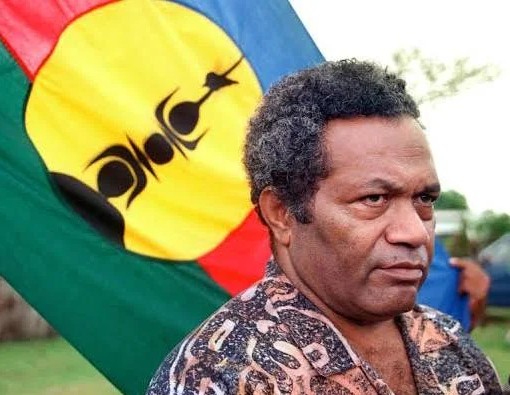
Jean-Marie Tjibaou (1936-1989) :

- Charismatic independence leader for New Caledonia
- Ex- priest, educated politician whose arguments used logic *
- Fought for awareness of Kanak identity and independence
- President of FLNKS, the party overseeing Kanak independence
- Designed the Kanak flag, recently seen jointly with the tricolore
- Devised and signed the tripartite Matignon Accords (Paris 1988)
- Independence announced for 1998. Independentists killed
- Was assassinated by an extremist of his own side in 1989.

Jean-Marie Tjibaou (son, Emmanuel, currently a member of the French National Assembly for New Caledonia) coined the phrase “PACIFIC MY NUHOM” [Pacific, My New Home], to show the links between his country and the Melanesian countries of the
Pacific (Papua New Guinea, Solomon Islands and Vanuatu). He
spoke with passion, persuasion of the similarities in their
histories, languages, and customs.

Further he was also able to resolve two demanding situations:

1. The PNG leadership was unable to support him because Bernard Narakobi who held a philosophy of Melanesia did not come to power in PNG. Yet thanks to the Non-Aligned Movement of newly independent Vanuatu, Tjibaou was supported at the United Nations Assembly in 1986 with a vote confirming: ‘the inalienable right of the people of New Caledonia to self-determination’

2. François Mitterand (of the Socialist Party) became President but was not able to support him early on. Yet Tjibaou succeeded
to negotiate with his Prime Minister Michel Rocard ‘Les Accords de Matignon’ in 1988 when he led the pro-independence delegation while Jacques Lafleur, a ‘Caldoche’ or New Caledonian of European origin led an anti-independence delegation. They shook hands. The photo of the ‘handshake’ shocked some of his younger extremists (this may have led to his assassination).

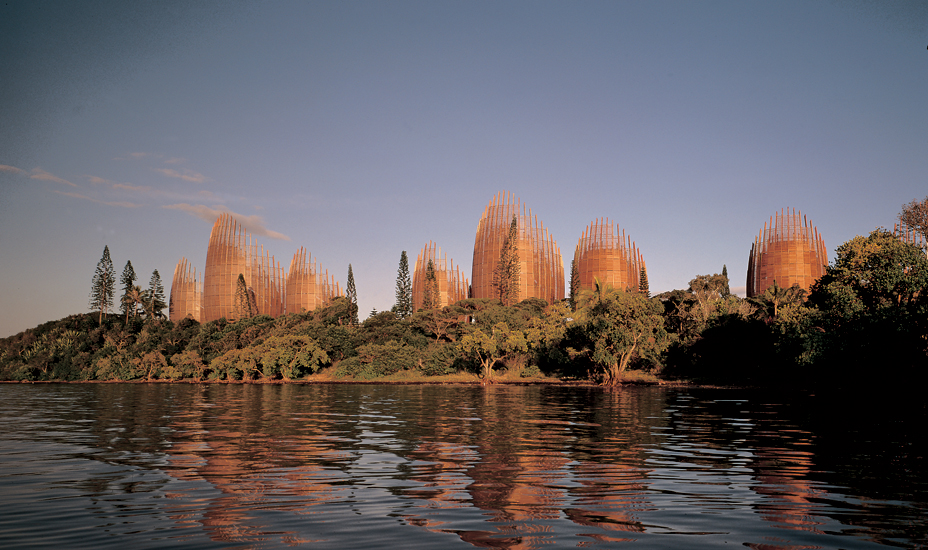
Jean-Marie Tjibaou’s name was given to a newly designed Cultural Centre (see above) inaugurated in Noumea (1998) to add value to the Kanak Culture, a project he had initiated at the time of the Matignon Accords. It is an Agency for the development of the Kanak Culture and is led by his widow Marie-Claude Tjibaou.

Further the two men involved with Rocard in the handshake were awarded in 2010 (this was posthumous for J M Tjibaou) ‘La Colombe de la Paix,’ an annual prize via Germany supported by UNESCO.

*Quote:
We want the right to Independence in our country. It is not more racist than to speak of having French citizenship.


JEAN-MARIE TJIBAOU: son héritage pour Kanaky-Nouvelle Calédonie

Lorsque j’étais en Papouasie Nouvelle Guinée, à l’université, dans les années 1980, j’ai eu l’occasion extraordinaire de traduire à un forum sur le Pacifique le discours de :

Jean-Marie Tjibaou (1936-1989)

- leader indépendantiste charismatique de la Nouvelle-Calédonie
- prêtre défroqué, politicien éduqué, de parole raisonnée*
- lutta pour faire reconnaitre : identité kanak et indépendance.
- président du FLNKS, parti pour l'Indépendance
- dessina le drapeau pour 'Kanaky', récemment joint au tricolore
- négocia (Paris) en tripartie, signa les Accords de Matignon 1988
- prévu l’Independence pour 1998, mais Indépendantistes tués
- a été assassiné par un extrémiste de son propre camp en 1989.

Jean-Marie Tjibaou (dont le fils, Emmanuel, représente 'Kanaky' en ce moment comme membre de l’Assemblée Nationale en France) a inventé une phrase inclusive: ‘PACIFIC MY NUHOM’ [Pacific My New Home]. Il a démontré les liens de son pays avec les pays Mélanésiens du Pacifique ( Papouasie Nouvelle Guinée, Les Iles Solomon et Vanuatu) et a parlé avec passion et logique des similitudes d’histoire, de langues et coutumes.

Plus tard il réussira à résoudre deux autres situations difficiles.

1 Les leaders de PNG ne pouvaient l’aider car Bernard Narakobi malgré une philosophie de Mélanésie n’a pas pris le pouvoir. Mais Tjibaou réussit à se joindre au ‘Mouvement Non-aligné’ de Vanuatu, nouvellement indépendant et de faire agréer et voter aux Nations Unies en 1986 : ‘le droit inaliénable des peuples de la Nouvelle Calédonie à l’auto-détermination’.

2 François Mitterand du parti Socialiste devint President en 1981 mais ne l’a pas soutenu dès le début. Tjibaou réussit néanmoins à négocier grâce au Premier Ministre Rocard les Accords de Matignon en 1988 : il mena une délégation indépendantiste jointe avec la délégation anti-indépendantiste du député NC Jacques Lafleur. Ils se sont serrés la main et la photo de cette ‘poignée de main’ a choqué des jeunes extrémistes de son mouvement (ce qui a pu être la cause de son assassinat).

Jean-Marie Tjibaou avait donné son nom au Centre Culturel (ci- dessus) inauguré en 1998 à Nouméa pour valoriser la culture
kanake qu'il ’avait projeté au moment des Accords de Matignon. Cette Agence pour le Développement de la Culture Kanak est
tenue par sa veuve Marie-Claude Tjibaou.

Plus récemment les deux hommes de la ‘poignée de main’ ont reçu en 2010 (à titre posthume pour J M Tjibaou) la ‘Colombe de la Paix’, prix annuel de l'Allemagne soutenue par l'UNESCO.

* Citation
Nous voulons le droit d’avoir l’Indépendance de notre pays. Ce n’est pas plus raciste que de parler d’une citoyenneté Française.

Freedom: Embracing change and identity

Featured

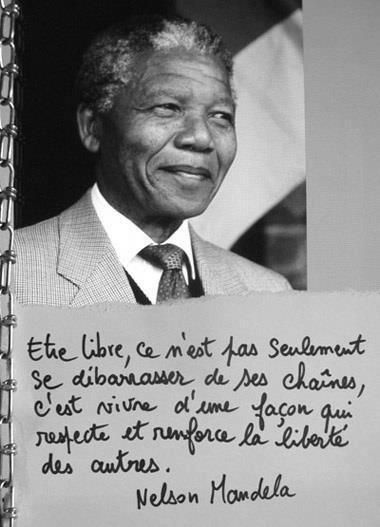
                    “For to be free is not merely to cast off one's chains, but to live 
in a way that respects and reinforces others' freedom.”

Nelson Mandela, Long Walk to Freedom, 1994.
[Pinterest Pic]
Looking for Freedom: Embracing change and identity


Freedom came to me
the day I moved from home,
my folk living in a gendarmerie.

I withdrew from France,
I left, and rejected
all my parents had intended for me.

Straight across to England I faced its frozen winds.
With luck I happened to bump into a young man
who wanted to travel, so we went overseas.

To Africa where Zambia became Independent.
Years of pleasure in the teaching
of the young and motivated learners!

Following old traditions that seemed new to me,
I adapted, out in the bush, used a hot water bottle
for my newborn who needed an incubator.

Then in the Pacific, Papua New Guinea
also gained its Independence. My family surrounded
by varied Indigenous folks who spoke multiple languages.

Travels and friendships were soon to end.
Integrated I’d thought, but we were to migrate.
Australia. How would it modernise our lifestyle?

There, ‘shock and awe’, we glared. Who’d fill the gap,
to bring in the Aborigines, who possessed less resources
than our friends in Africa or the Pacific?

I’d need to free myself again. I didn’t want to become
more French than before. Still I remained wondering
how long it’d take for Aboriginal culture
to become ‘respected and reinforced’, here.


Liberté : Accueillir un renouveau d’identité


La liberté, je l’ai cherchée.
Je décidai, un jour, de quitter la maison,
mon père gendarme, je partis sans les clés.

J’abandonnai la France, rejetai mon passé
tout ce que mes parents pour moi auraient voulu.
Je laissai ma famille et traversai la Manche.

Les vents Anglo-Saxons me refroidirent.
Enfin, je rencontrai un jeune homme qui voulait
rallumer sa vie en voyageant à l’étranger.

En Afrique, la Zambie prit son indépendance.
Des années de plaisir à enseigner
des étudiants jeunes et très motivés !

Des traditions anciennes, quoique nouvelles pour moi.
Je m’adaptai. Un jour en pleine brousse, mon bébé
n’eut pour couveuse qu’une simple bouillotte toute chaude.

Plus tard dans le Pacifique, La Papouasie Nouvelle Guinée
eut, elle aussi, son Indépendance. Ma famille fut alors entourée
de personnes Indigènes dont les langues offraient multiples variétés.

Soudain les voyages et les rencontres amicales se terminèrent,
je me croyais intégrée mais l’heure de notre rapatriement arriva.
Emigrants en Australie, aurons-nous une vie plus modernisée ?

‘Le choc et l’admiration’ deviennent ‘Rapide Dominance’.
Comment garnir accès pour les Aborigènes
qui avaient moins de ressources que nos amis
d’Afrique ou du Pacifique ?

Aurais-je donc le temps de me relibérer
Ou deviendrais-je plus Française qu’avant ?
Mais combien de temps pour que la culture
Aborigène soit ‘respectée et renforcée’, ici ?


Celebrating 50 Years of Papua New Guinea’s Independence

Featured

This week is the fiftieth anniversary of Independence in Papua New Guinea. Our family’s ten years in Port Moresby were extremely rewarding. We lived on the university campus from 1976 till 1986. The years after Independence were times of intense development. At the University, students told you they were proud of where they came from their [Ples] and their language [Tok Ples]. They were good enough to invite us to visit their region, no matter how far away they lived. 

We met interesting people in town, and my best friend nicknamed me Mauswarra [the mouth that runs fast in Tok Pisin], in the same way as my family in France used to say I was Un moulin à paroles [a continuous word-windmill in French]. If I still lived in Port Moresby, I would now be called Bubu Mama [Grandma in Hiri Motu].

I am grateful for the warm welcome we received and how much we learned about a varied country with amazing landscapes of soaring mountains and seaside beaches. We had a Christmas lunch at a windy Ella Beach: lettuce leaves flew off, but we were able to eat the slices of cold turkey that remained on our plates. Two events at Idler’s Bay: a difficult one when our daughter was stung by a jelly fish; and a cheerful one when we attended David and Faith’s wedding. We also had a wonderful time at Gabba Gabba where the villagers gave us cool and large watermelons to eat, and their children played cricket with ours. We went to Yule Island on an outrigger canoe with eskis full of supermarket fruit and came back with fresh coconuts.

We were lucky to fly inland to Tapini and back safely in spite of the difficult airstrip; went to Bulolo and Wau to look at the remnants of gold mining and to the best market in the world at Goroka where I bought two of my favourite bilums [traditional string bags]. We also met with friendly people in stunning Madang and in the Island of Bougainville who always expressed the love of self-sufficiency. I cannot do justice to this country, and I regret not visiting other exciting places, like Milne Bay, the Sepik, the Western Highlands, East and West New Britain and Manus.

Papua New Guinea has in excess of 800 languages, Austronesian and Non-Austronesian which are able to do things that western linguists never thought possible. Through verb-stringing and other infixes languages focus on the manner of an action rather than on its timing, which is marked by adverbs. Besides liklik Tok Pisin and Hiri Motu bada (not really ‘much’!) I would have loved to learn languages from the Goilala people.

When we left UPNG students and staff organised a mumu, pig cooked in the ground with taro and vegetable wrapped in banana leaves as a farewell party.

On behalf of my family, it is my pleasure to wish all my friends and their wantoks [relatives], whom I cannot name here because I’d be sure to forget someone special, and in honour of those that have passed away, my absolute best for the 50th Independence Day Celebration on 16th September 2025.

Having a good time / Comment bien s’amuser

Featured
Having a good time

Having a good time is hard. I cannot do it on my own. I need folk around me, a good number is about ten. I like to mix with people I’ve met before, who are from a range of ages. It doesn't mean I will talk to them all at once. It’s more dynamic if we sit down, eat and drink together.

All of a sudden the calmest person in the room makes a joke about what you wear and how strange your voice is. After this, no end of jokes sparkle making us laugh. Somebody declares finding the venue was a real nightmare. Then others complain I delayed them because I went early to their sister’s house hoping to get a lift. It was, they say, the wrong time and the wrong place. Then I burst out laughing and we all have a giggle. My friends take some photos of me scratching my head.

It’s best if I’m able to make fun of me. It is at that stage I realise I’m having a good time at last.


Comment bien s’amuser

Il est difficile de bien s’amuser. Mais je ne sais pas faire ça toute seule. J’ai besoin de monde autour de moi, environ dix est un bon nombre. Il s’agit de personnes d’âge différent que je connais déjà. Il est évident qu'on ne se parlera pas tous en même temps. Pour la dynamique de ce groupe, le plus simple est de s’asseoir, de manger et boire ensemble.

Soudain la personne la plus calme du groupe fait une plaisanterie sur tes habits et dit que tu parles de façon bizarre. A ce moment là, toute la salle éclate de rire. Quelqu’un assure que le chemin qu’on a pris pour venir à cet endroit donnait l’impression qu’on était parti au bout du monde. D’autres se plaignent que je les ai retardés car je m’étais trompée de point de départ. J’’étais arrivée chez sa sœur très tôt. J'étais là, me dit-on, à un mauvais moment et à la mauvaise adresse. Tout le groupe se met à rire, moi aussi. Quelqu’un prend ma photo pendant que je me gratte la tête.

Tout va bien si je réussis à me moquer de moi. C’est là que je me rends compte que je m'amuse.

Three French chansons/ 1970s Nostalgia

Featured

( Thanks to Salvatore Adamo, Joe Dassin, Yves Duteil – Lyrics below)

A tune and a few words.
I hum a song or two.
I remember Tombe la neige
At the trail end of the nineteen sixties.
Adamo sings of a lover’s distress
Emotions buried by steady snowfalls.

Next I follow dreams and wishes of those
who mastered obstacles
They reveal their dynamic life
and a rhythm to sink all pessimism.
My voice attracted by Dassin’s
Taps to the refrain : Aux Champs Elysées.


I leap into action
with the energy and passion
of the adults and the parents
who relish their new lives
and will revel in inclusivity.
Prendre un enfant par la main
Walking with a child near you,
and holding their hands as a way
of 'giving them the confidence to walk'
Going with Duteil to find snow
And maybe the gift of optimism.


Salvatore Adamo – Tombe la neige
Tombe la neige
Tombe la neige
Tu ne viendras pas ce soir
Tombe la neige
Et mon cœur s’habille de noir
Ce soyeux cortège
Tout en larmes blanches
L’oiseau sur la branche
Pleure le sortilège
Tu ne viendras pas ce soir
Me crie mon désespoir
Mais tombe la neige

Tombe la neige
Tu ne viendras pas ce soir
Tombe la neige
Tout est blanc de désespoir
Triste certitude
Le froid et l’absence
Cet odieux silence
Blanche solitude
Tu ne viendras pas ce soir
Me crie mon désespoir
Mais tombe la neige
Impassible manège


Joe Dassin – Aux Champs Elysées
Je m’baladais sur l’avenue
Le cœur ouvert à l’inconnu
J’avais envie de dire bonjour
À n’importe qui
N’importe qui et ce fut toi
Je t’ai dit n’importe quoi
Il suffisait de te parler
Pour t’apprivoiser

Aux Champs-Élysées
Aux Champs-Élysées
Au soleil, sous la pluie
À midi ou à minuit
Il y a tout c’que vous voulez
Aux Champs-Élysées

Tu m’as dit “J’ai rendez-vous
Dans un sous-sol, avec des fous”
Qui vivent la guitare à la main
Du soir au matin”
Alors, je t’ai accompagnée
On a chanté, on a dansé
Et l’on n’a même pas pensé
À s’embrasser


Yves Duteil – Prendre un enfant par la main
Prendre un enfant par la main
Pour l’emmener vers demain
Pour lui donner la confiance en son pas
Prendre un enfant pour un roi

Prendre un enfant dans ses bras
Et pour la première fois
Sécher ses larmes en étouffant de joie
Prendre un enfant dans ses bras

Prendre un enfant par le cœur
Pour soulager ses malheurs
Tout doucement, sans parler, sans pudeur
Prendre un enfant sur son cœur

Prendre un enfant dans ses bras
Mais pour la première fois
Verser des larmes en étouffant sa joie
Prendre un enfant contre soi

Prendre un enfant par la main
Et lui chanter des refrains
Pour qu’il s’endorme à la tombée du jour
Prendre un enfant par l’amour

Prendre un enfant comme il vient
Et consoler ses chagrins
Vivre sa vie des années, puis soudain
Prendre un enfant par la main

En regardant tout au bout du chemin
Prendre un enfant pour le sien