Roebourne (Ieramugadu)-my favourite small town in Australia (Bilingual)

Featured
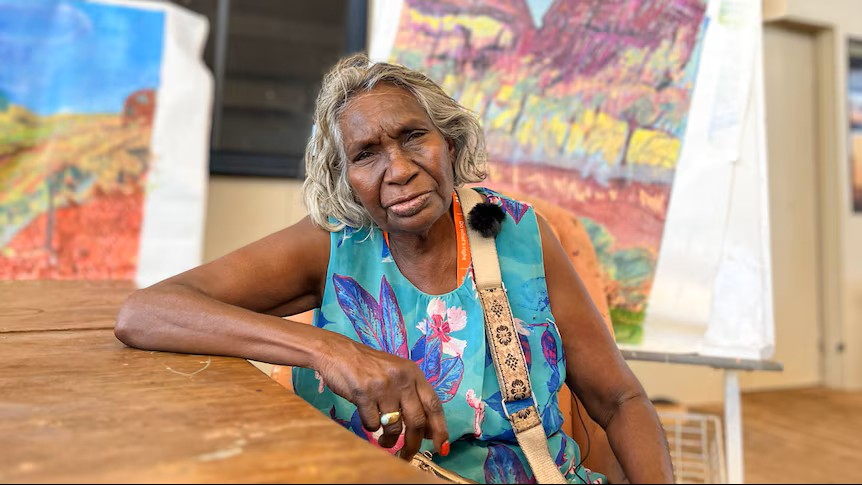
Wendy Hubert – courtesy ABC News

Why Roebourne is my favourite small town in Australia

In March 2026 Yindjibarndi Elder Wendy Hubert and Juluwarlu Art Cooperation 
travelled 5,000 km by road from Roebourne to Sydney as guests of the Sydney Biennale.
Links:
- Indigenous artworks taken on 5,000km road trip from the Pilbara to Biennale of Sydney - ABC News
- Wendy Hubert | 25th Biennale | Rememory | SBS On Demand


Roebourne [Ieramugadu, in Ngarluma; population 981-2016 census ],
is located within the City of Karratha at 1,563 from Perth (West Australia)
From 1930-1950 it was a non-Indigenous administrative centre.
The Yindjibarndi, Kuruma, Yaburrara, Marthudunera, Banjima, and
Kariyarra people were gathered to camps and reserves with controls and
curfews placed on Aboriginal people’s movements to, from, and within
the town. Later, iron-ore mining enterprises constructed company towns
and moved people from the crowded surrounds into Roebourne in the
1960s.

Exile and the Kingdom www.sbs.com.au/ondemand/tv-series/exile-and-the-kingdom
an award-winning documentary captured the spirit of the town, narrated by
a late elder with the Yindjibarndi, Ngarluma, Banyjima and Kurrama people
of Roebourne. It recounts the experiences of the Aboriginal community
from pre-colonial times to the 1990s.

Community centres in Roebourne include a Health Centre, an Aged
people’s home, a library, a primary and secondary school. It holds cultural
centres like the Ngarluma Yindjibarndi Foundation Ltd, and the media
station https://www.ngaardamedia.com.au/ngaarda-radio. Preserving the
Yindjibarndi history & culture Juluwarlu https://juluwarlu.com.au/ documents
the ngurra (the land) with the help of artist like Yindjibarndi Elder Wendy
Hubert while teacher, linguist and artist, Allery Sandy, runs the art centre
‘Yinjaa-Barni (Working Together)’ (www.yinjaa-barni.com.au)

Wanthiwa’ is the Yindjibarndi ‘Welcome’ word I heard when I walked
down the streets in Roebourne. I met the ‘strong’ women and men that
made the town real, similar to when I lived in France and people always
greeted each other. I enjoyed walking alongside families sitting on the
verandah. The town residents also walked from one house to the other
to consult with one another, as against those who walk for exercise,
which most of us do in Australia, without talking to anyone. I have fond
memories of families sitting on the verandah. This contrasted with life
in Karratha where I lived, driving from one spot to the next, usually in
large 4 x 4 vehicles and only seemed to speak to people in shops or
offices. I worked as the Roebourne Prison Education Officer for three
years where a majority of Indigenous people spent spells of months or
years as minimum priority prisoners, often for fine overloads or
breaching a driving licence. There I ran the Education Centre
where prisoners used their time catch up with their education which
had been interrupted.

Community gatherings I later worked for the local shire and organised
exchanges between the Indigenous community and the multicultural
residents of the local towns. We shared picnics with a taste of kangaroo
tails cooked in the ashes. A gathering is held in early July for all the older
Aboriginal people to celebrate their birthdays, given that their birthdates
were never registered.

In Australia’s massive country, this compact town will always have a place
in my heart.
Roebourne , ma petite ville préférée en Australie
En mars 2026, Wendy Hubert, aînée Yindjibarndi, et Juluwarlu Art
Coopération ont parcouru 5 000 km par la route, de Roebourne à
Sydney, en tant qu’invités de la Biennale de Sydney. Links below:
Indigenous artworks taken on 5,000km road trip from the Pilbara to Biennale of Sydney - ABC News
Wendy Hubert | 25th Biennale | Rememory | SBS On Demand

Roebourne, dont le nom est Ieramagadu dans la langue Ngalurma avait
une population de 981 habitants au recensement de 2016, est située dans
l’agglomération de Karratha à 1563 km de Perth (capitale de l’Australie
Occidentale). De 1930 à 1950 ce fut un centre administratif non-
Autochtone. Les peuples Yindjibarndi, Kuruma, Yaburrara,
Marthudunera, Banjima et Kariyarra furent regroupés dans des camps
et des réserves. Des contrôles et des couvre-feux furent imposés aux
Aborigènes quant à leurs déplacements à destination, en provenance et
à l'intérieur de la ville. Plus tard, dans les années 1960, des entreprises
minières de minerai de fer construisirent des villes ouvrières et
déplacèrent les populations d’un environnement surpeuplé vers
Roebourne.

Exile and the Kingdom www.sbs.com.au/ondemand/tv-series/exile-and-the-kingdom
un documentaire primé, a capturé l’esprit de la ville, narré par un ancien
aujourd’hui disparu des peuples Yindjibarndi, Ngarluma, Banyjima et
Kurrama de Roebourne. Il relate l’histoire d’une communauté aborigène,
des temps précoloniaux aux années 1990.

Les Centres de communauté de Roebourne consistent d’une clinique,
d’un centre pour personnes âgées, d’une bibliothèque et une école
primaire et secondaire. La ville contient la Fondation Ngarluma
Yindjibarndi Ltd et une media https://www.ngaardamedia.com.au/ngaarda-radio
Le groupe de Juluwarlu https://juluwarlu.com.au/ se concentre sur l’histoire
et la culture documente le ngurra (la terre natale) avec l’aide d’artistes
comme l’aînée Yindjibarndi Wendy Hubert. Un autre studio d’art le
Yinjaa-Barni (Le Travail Ensemble) www.yinjaa-barni.com.au est tenu
par l’aînée Yindjibarndi Allery Sandy, institutrice, linguiste et artiste.

Wanthiwa est le mot Yindjibarndi pour «Bienvenue» que j’entendais en
passant dans les rues de Roebourne. Je fis connaissance de femmes ‘fortes’
et de leurs partenaires qui rendent la ville vraiment réelle, me rappelant
ma vie en France quand les gens se saluaient toujours. J’aimais bien voir
toutes les familles assises sur leurs vérandas lorsque je passais dans la rue.
Là les résidents allaient d’une maison à l’autre pour discuter entre eux,
ce qui était le contraire de ceux qui se promènent pour faire de l’exercice,
comme nous le faisons tous en Australie, sans jamais parler à personne.
Ceci était un contraste avec la vie à Karratha où j’habitais, et où on
conduisait d’un endroit à l’autre, le plus souvent dans de gros véhicules
4x4 et où on ne parlait aux gens que dans les bureaux ou les magasins.
Je travaillais pendant trois ans dans le centre d’éducation de la Prison
Régionale de Roebourne où il y avait une majorité de prisonniers
Indigènes qui étaient condamnés à une peine minimale de quelques
mois ou années, soit pour des amendes accumulées ou pour infractions
au permis de conduite. Là j’organisais le Centre d’Education et les
prisonniers utilisaient ce temps-là pour se rattraper sur leurs études
qui avaient été interrompues.

Réunions entre groupes communautaires J’ai travaillé ensuite pour
la municipalité et facilité les échanges entre groupes Indigènes et
groupes multiculturels de la région. Nous avons fait des pique-niques
et gouté 'la queue de kangourou cuite dans les cendres'. Tous les ans,
début juillet, la communauté organise une journée pour célébrer
l’anniversaire des personnes Aborigènes âgées car leurs naissances
n’avaient pas été enregistrés.

Dans l'immense pays qu'est l'Australie, cette petite ville aura toujours
une place dans mon cœur.

Shingles and Sciatica/ Zona et Sciatique- A personal ballad

Featured


A ballad to my tingling shingles

At a time when I had pain down my back,
and itchy spots came on my leg,
which hassled me down the seams of my jeans.
Revelation! It was shingles.

Toes close together, with no will to move,
and my leg dragged heavy as lead,
in the middle of the night in a bath,
I’d hum tunes to my poor sore toes.

Shuffling and limping was the only way
I could achieve going places.
Ensconced in thick socks, my toes stayed stone cold,
My world was quite amiss.

Mixed with sciatica, shingles’ trouble.
Two of my toes are lifeless now.
One year gone by, and I'm not antivax,
a jab to save my other toes.


Une ballade sur mon zona irritant

Un jour ayant des douleurs dans le dos
des boutons me piquèrent la jambe
tout le long de la couture de mes jeans.
Révélation, c’était l’ zona !

Mes orteils sans volonté, compressés,
et la jambe trainant comme du plomb,
la nuit, les doigts d’pied plongés dans le bain
je leur chantonnai des comptines.

Tout en boîtant et en trainant les pieds
j’arrivai à me déplacer.
Mes orteils enfoncés dans d’énormes chaussettes
restèrent froides. Et ma vie clochait.

Sciatique liée au zona m’accablèrent,
Deux de mes orteils ont péri.
Et cette année, n’étant pas antivax,
piqûre! Pour qu’il m’reste d’autres orteils !


How I wish I still lived on the edge

Featured


How I wish I still lived on the edge


As soon as I left home, I grasped a life of change
riding a motorbike and smoking cigarettes
to counter my parents’ humdrum daily lifestyle.

A milestone came for me the year of moon landing,
I took one giant step, went to Mwinilunga.
In North Western Zambia, at the Zambezi source,
new folk shared food with me.

No electricity. We burnt wood in the stove,
kerosene in the lamps and had a few candles
Often left stains of wax on students’ homework books.

At open air concerts, villagers came to sing,
to booming drums we danced the Congolese Rumba.
I even joined when eight months’ pregnant.

No newspapers in town. A radio and batteries.
The sun shone over us its healthy radiant heat.
At night, the stars sparkled.

Traces of defiance and of independence
are still burning in me.
I’ve danced myself away at cultural events,
backed First Nations’ requests that their voices be heard.

Yet I’m still waiting to see sparkling stars
enlighten the modern world I live in.
Suburbia be damned!


Comme je voudrais encore vivre en marge de ce monde

Quand j’ai quitté mes parents j’ai vécu une vie différente
Circulant en moto et fumant des cigarettes.
Pour contre-carrer leur train-train habituel .

Une étape importante est arrivée pour moi
l'année de l'alunissage, j'ai fait un pas géant,
Partie pour la Zambie dans le Nord-Ouest
Là, à Mwinilunga, à la source du Zambèze,
de nouveaux amis partageaient leur nourriture avec moi.

Pas d’électricité. Chez nous, un four à bois,
une lampe au kérosène, quelques bougies.
Souvent on laissait des tâches de cire
en corrigeant les cahiers des élèves.

Les concerts étaient en plein-air.
les habitants venaient chanter,
Nous dansions, au bruit de tambours sonores,
la Rumba Congolaise à laquelle j’ai osé
me joindre, bien qu’enceinte de huit mois.

Pas de journaux en ville. Une radio et des piles.
Le soleil chaleureux chauffait avec radiance.
La nuit, toutes les étoiles étincelaient.

Des traces d’indépendance et de défi
brûlent encore en moi.
J’ai dansé comme une folle
Du temps de réunions interculturelles.
J’ai soutenu les requêtes des Premières Nations
qui voulaient qu’on écoute leurs voix et leurs paroles.

Mais j’attends encore voir un scintillement d’ étoiles
éclairer le monde moderne que j’habite.
Maudite soit la vie en banlieue !


The prickly shrubs of life (D’apres Ronsard)

Featured

The prickly shrubs of life 

Why care with such vigour for loose and fluffy scraps,  	
The past webs of your life that have drifted beyond
Nurture thyself with care and new probes will open
Why wait to enjoy life, you shouldn’t hold-up time! 

Success will become you, the feisty self-starter
Dance to musical timbres, your mood will brighten up
And your dreams will revive the pirouettes of your youth
Why wait to enjoy life, you shouldn’t hold-up time!

One night in your dotage you will evoke the days
When you chose to absorb the beauty of your world
Why wait to enjoy life,  you shouldn’t hold-up time!

Skip along the rhythms of the dramatic drums 
Why wait to enjoy life,  you shouldn’t hold-up time!                    
Pick from today’s ramble the prickly shrubs of life.  


Quand vous serez bien vieille 
(Ronsard - Sonnets pour Hélène, 1578) 

Quand vous serez bien vieille, au soir, à la chandelle,
Assise auprès du feu, dévidant et filant,
Direz, chantant mes vers, en vous émerveillant :
Ronsard me célébrait du temps que j’étais belle.

Lors, vous n’aurez servante oyant telle nouvelle,
Déjà sous le labeur à demi sommeillant,
Qui au bruit de mon nom ne s’aille réveillant,
Bénissant votre nom de louange immortelle.

Je serai sous la terre et fantôme sans os :
Par les ombres myrteux je prendrai mon repos :
Vous serez au foyer une vieille accroupie,

Regrettant mon amour et votre fier dédain.
Vivez, si m’en croyez, n’attendez à demain :
Cueillez dès aujourd’hui les roses de la vie.

Yesterday’s memories (Bilingual)

Are you there, memories?

Yesterday’s memories are unreliable. Who is the baby in the picture? 
What is the name of that beautiful beach?  Ah, Hawaii, I went there 
once, but when was that? I used to send postcards to my friends 
and family. But where are these now? The postcards recycled, 
the stamps redistributed. Many of my friends are departed, 
my memories are no longer available to anyone, 
not even to me. When I tell my grandchildren 
about the past, what I don’t exactly recall
might be made up. 
Are you there, memories? 
I cannot guarantee 
the events are real 
but we had fun!


Où-sont donc mes souvenirs d’antan ? 

Ne vous fiez-pas aux souvenirs anciens. Qui est ce bébé sur la photo ?  
Quelle est cette  jolie plage ? Oui, Hawaii j’y suis allée, mais quand ?  
Où vais-je trouver maintenant les cartes postales que j’envoyais 
à mes amies, à ma famille ? Les cartes sont recyclées 
les timbres redistribués. Bien d’amies parties, 
les souvenirs ne nous sommes plus possibles 
même pas pour moi. Quand je raconte 
des histoires à mes petits-enfants 
tout ce que j’ai presque oublié 
sera peut-être  inventé. 
Où-sont donc mes souvenirs d’antan ? 
je ne garantie pas la vérité 
des évènements, mais
on s’amusait bien.


Piano Tunes

Piano Tunes

The piano plays Autumn Leaves, the barista is calling ‘Latte for Emma’
We go up for art class with the pianist singing Happy Birthday to you
Near the lift I look up and say ‘Lucky me, she sings for my birthday’
The woman in the red two-piece suit says ‘Best wishes to you’
The others are looking away. They don’t believe me.
In a nursing home some will never know the day
Or be sure whether it’s their birthday. I add
‘My grandson Danny called me today .’
The pianist starts Danny Boy
And they’re staring at me.

Piano et Chansons

La pianiste chante Les Feuilles Mortes, le barista crie ‘Café-au-lait, Emma’
Quand on monte faire de la peinture la pianiste chante Bon Anniversaire
Devant l’ascenseur j’ose me faire entendre ‘C’est pour moi la chanson’
La femme en costume rouge et en noir me dit ‘ Mes Félicitations’
Les autres ne me regardent pas, je vois qu’ils ne me croient pas
Dans une maison de repos on oublie quelquefois la date
Très peux sauront le jour de leur anniversaire. J’ajoute
‘Et Danny mon petit-fils m’a fait un coup de fil.’
La pianiste entonne ‘Danny Boy’
Et tout le monde me regarde.