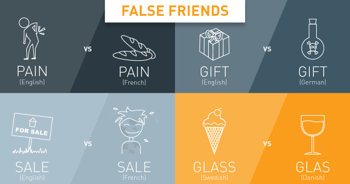

'False friends': words which although similar are not equivalent across two languages.

 Faux amis' : mots dont la resemblance entre deux langues n'est pas équivalente.


1  Syntax / Word type

     Ici c’était à la télévision,

     and there it was seen on television.


2  Syntax  / Word type

     Bienheureux est toujours le contraire de malheureux

     although content(e) [pleased] doesn’t mean the same as content.


3  Lexis /Word choice

     On fait attention aux contradictions et aux ‘faux-amis’,

     which may (or not) have given birth to the phrase fake news'.


4 Lexis /Word choice

      Chez moi en France signifie à la maison,

      but in England a home is said to be one’s castle.


5 Lexis /Word choice

      J'ai mal au ventre,

      but my stomach aches.


6  Lexis /Word choice

     En  cinq mots le qu’ en dira - t- on fait survivre les journalistes,

     but the media loves a one-letter gossip.


7 Semantics /Word meaning  Nerveuse  (of a person) : [Restless]

      On me dit toujours que je suis une personne nerveuse et agitée.

      They always say I am a fidgety and restless person.


Semantics Word meaning  Nerveux (of an action) : [Nervous]

      The woman’s nervous laugh betrayed her anxious state of mind.

      Le rire nerveux de la femme trahissait son inquiétude.


8  Pragmatics/Word context

     Ayant signalé le vol à la police, il me tardait de rentrer chez moi.

     I reported the theft to the police and was desperate for a cup of tea.


9 Pragmatics / Word context

      Merci peut indiquer le négatif (NEG)

      Thank you always is a positive statement (POS)

      Examples:    (Fr) : Du sucre? / (Eng) : Sugar?
        (NEG): Merci (pas pour moi)  /(POS)Thanks /Yes, please


10 Phonology /Word Sound

      Le bruit des ‘twitters’ commencent par le b de brouhaha,

      although we may hear the h of hubbub made by the twitterers.


Any more similar examples welcome (English with any other language!)

Tout autre exemple similaire est le bienvenu (Français-Anglais ou autre langue)


You must be logged in to post a comment.