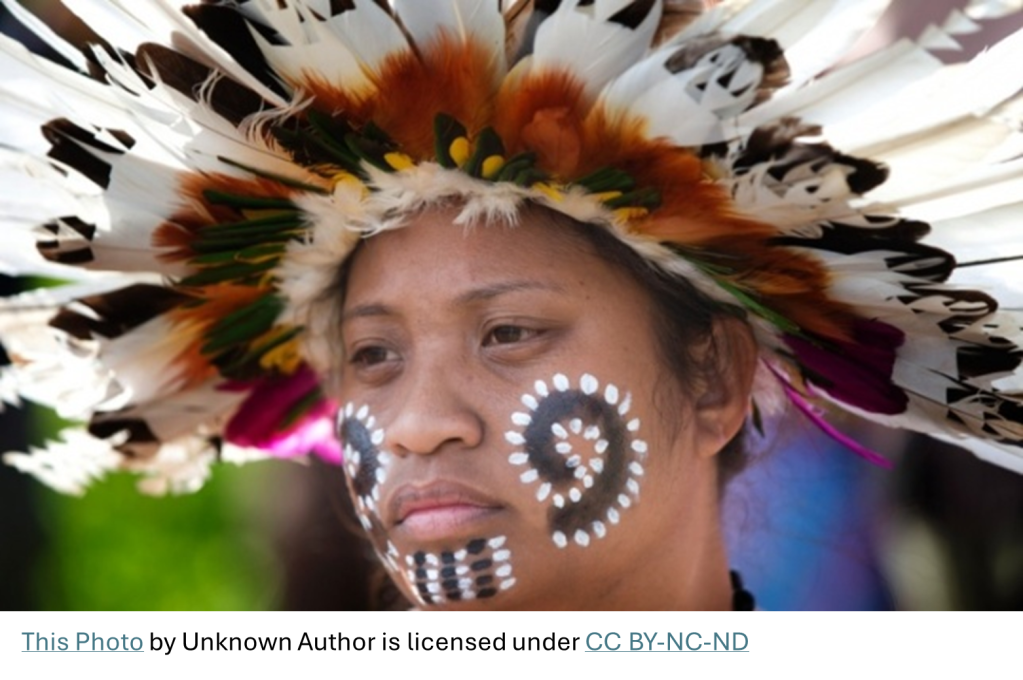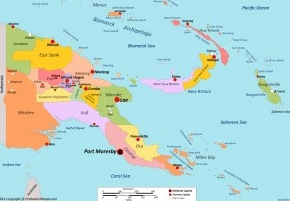

This week is the fiftieth anniversary of Independence in Papua New Guinea. Our family’s ten years in Port Moresby were extremely rewarding. We lived on the university campus from 1976 till 1986. The years after Independence were times of intense development. At the University, students told you they were proud of where they came from their [Ples] and their language [TokPles]. They were good enough to invite us to visit their region, no matter how far away they lived.
We met interesting people in town, and my best friend nicknamed me Mauswarra [the mouth that runs fast in Tok Pisin], in the same way as my family in France used to say I was Un moulin à paroles [a continuous word-windmill in French]. If I still lived in Port Moresby, I would now be called Bubu Mama [Grandma in Hiri Motu].
I am grateful for the warm welcome we received and how much we learned about a varied country with amazing landscapes of soaring mountains and seaside beaches. We had a Christmas lunch at a windy Ella Beach: lettuce leaves flew off, but we were able to eat the slices of cold turkey that remained on our plates. Two events at Idler’s Bay: a difficult one when our daughter was stung by a jelly fish; and a cheerful one when we attended David and Faith’s wedding. We also had a wonderful time at Gabba Gabba where the villagers gave us cool and large watermelons to eat, and their children played cricket with ours. We went to Yule Island on an outrigger canoe with eskis full of supermarket fruit and came back with fresh coconuts.
We were lucky to fly inland to Tapini and back safely in spite of the difficult airstrip; went to Bulolo and Wau to look at the remnants of gold mining and to the best market in the world at Goroka where I bought two of my favourite bilums [traditional string bags]. We also met with friendly people in stunning Madang and in the Island of Bougainville who always expressed the love of self-sufficiency. I cannot do justice to this country, and I regret not visiting other exciting places, like Milne Bay, the Sepik, the Western Highlands, East and West New Britain and Manus.
Papua New Guinea has in excess of 800 languages, Austronesian and Non-Austronesian which are able to do things that western linguists never thought possible. Through verb-stringing and other infixes languages focus on the manner of an action rather than on its timing, which is marked by adverbs. Besides liklik Tok Pisin and Hiri Motu bada (not really ‘much’!) I would have loved to learn languages from the Goilala people.
When we left UPNG students and staff organised a mumu, pig cooked in the ground with taro and vegetable wrapped in banana leaves as a farewell party.
On behalf of my family, it is my pleasure to wish all my friends and their wantoks [relatives], whom I cannot name here because I’d be sure to forget someone special, and in honour of those that have passed away, my absolute best for the 50th Independence Day Celebration on 16th September 2025.
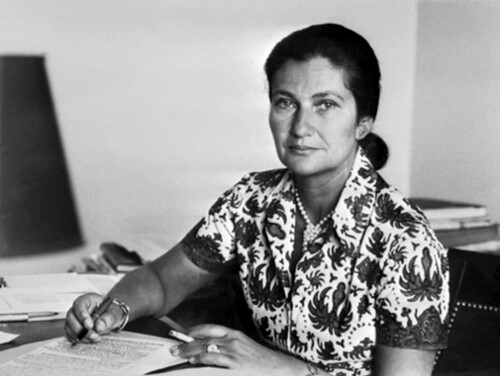
Who would still confuse Simone Veil (1927-2017) with Simone Weil, a humanist and mystic philosopher who died young in England (1909-1943)? Both women with similar names are from France, my country of origin.
It is Simone Veil I want to discuss. She was a French politician as well as a holocaust survivor. While studying for her Baccalauréat in April 1944, she was arrested by the Gestapo together with her whole family in Nice.
Her father and brother were deported to Lithuania. Never seen again, they were listed as executed. With her mother and two sisters she went to Auschwitz and later went on the ‘death march’ to Brobeck and Bergen-Belsen. There her mother died of Typhus while Simone who said she was below eighteen was enlisted to do forced labour. The three sisters managed to be released separately from 1945.
On her return Simone studied law and politics and later became the French Minister for Health. I was thirty years old when in 1975 the 'Veil Act' to legalise abortion was passed. I heard her dedicated speeches in the National Assembly that affirmed a woman’s right to bring pregnancy to interruption. She was convincing and managed to rally all the male representatives of the National Assembly.
This was significant for me who had witnessed through some good friends of mine the difficulties women had to survive because of numerous illegal abortions in the 1960s in France. Since then Simone Veil received the nickname of ‘La Merveille’ [La Mère Veil - The Marvellous Mother] from women and feminists who respect and revere her.
Indefatigable as a politician, she became the first woman to join the European Parliament and received a wide range of high-level awards eventually receiving the Légion d’Honneur in 2012. She was re-interred with her husband in the Pantheon in 2018.
Later a Prize, awarded on International Women’s Day, was instituted in her name to honour people who fight for women’s causes. Living overseas, I am lucky to have had access to ‘A Life,’ her 2009 memoir and to the 2022 film ‘Simone Veil A woman of the century.’
Simone Veil, femme qui m’a inspiré
Qui encore continue à confondre Simone Veil (1917-2017) avec Simone Weil, une philosophe humaniste et mystique qui mourut jeune en Angleterre (1909–1943) ? Deux femmes aux noms semblables venant de France, mon pays d’origine.
C’est de Simone Veil, dont je veux parler, une femme politique Française qui avait survécut l’holocauste. Elle préparait son Baccalauréat quand elle fut arrêtée avec toute sa famille par la Gestapo en Avril 1944 à Nice.
Son père et son frère, déportés en Lituanie n’ont jamais été revus et furent déclarés exterminés. Avec sa mère et ses sœurs elle partit pour Auschwitz et suivit les 'marches de la mort' à Brobeck, puis Bergen-Belsen où sa mère mourut du Typhus. Simone disant qu’elle avait moins de dix-huit ans fut retenue pour faire des travaux forcés. Les trois sœurs furent libérées séparément à partir de l’année 1945.
A son retour Simone fit ses études de droit et de politique, et plus tard devint Ministre de la Santé. J’avais 30 ans lorsque en 1975, la 'Loi Veil' légalisa l’avortement. J’ai entendu les discours de Simone Veil qui affirmait l’autonomie de la femme et son droit à une interruption volontaire de grossesse et qui réussirent à persuader tous les représentants masculins de l’assemblée nationale à faire passer cette loi.
C'était un moment important pour moi qui avait été témoin, par l'intermédiaire de quelques-unes de mes amies, des difficultés que les femmes avaient à survivre à cause des nombreux avortements illicites dans les années 1960 en France. Depuis cette année-là Simone Veil a reçu le surnom de ‘La Merveille’ [ la Mère Veil] par les femmes et les féministes qui l’ont révérée et profondément respectée.
Une politicienne infatigable elle devint la première femme élue au Parlement Européen et reçut un grand nombre de prix et La Légion d’Honneur lui fut remise en 2012. Récemment elle fut re-enterrée avec son mari au Panthéon.
Depuis un prix, présenté pour la Journée Internationale de la Femme, fut institué en son nom en honneur des personnes qui améliorent la cause de femmes. Bien que je vive à l’étranger, j’ai pu avoir accès, en Australie, à son mémoire: ‘Une Vie (2009) et au film de 2022 ‘Simone Veil - Une femme du siècle.’
Hi Martin. I’m Annie, social worker to-be. After last week’s request for a visit, I have come in to see if I can read to you, watch films with you, or if you want, practise skills like paper quilling, model building or animal tracking. This list gives you the selection of topics and a choice of our volunteers from the community centre. You do not have to agree. You make the decision, select the activity, the time and you tell me, It is totally your call: Yes, No or Maybe. Roland: I say yes. How about dancing a Tango now?
Bonjour Martin. Moi je suis Annie et je suis une aide-assistante sociale. La semaine dernière j’ai offert de venir vous voir pour expliquer ce que fait notre groupe. Je demande si je pourrais lire avec vous, ou regarder des films ensemble, si vous voulez apprendre à faire des objets en papier, à construire des modèles ou à suivre les traces d’animaux. Voici une liste de sujets à sélectionner ainsi que celle des bénévoles de notre centre urbain. Vous n’êtes pas obligé d’accepter, c’est vous qui prenez la décision. A vous de choisir l’activité et l’horaire, dites-le-moi et vous aurez le dernier mot, absolument. Oui, Non, ou Peut-être. Roland : Je vous dis oui. J’aimerais danser un Tango tout de suite.
[D’après François Villon’s Ballade ‘Frères humains qui après nous vivez’, 1489]
Sisters among whom I’ve enjoyed living, Those of you whose words I have read and heard, Women who ponder the choices we have, My daughters (and those later born of them), Sisters be aware, you are role models Forget the crude jests and crass abuses That mocked you and your personal beliefs The Uluru call was a people’s cry Own your power and claim: kulila*! People, be humane: listen to the voice.
Australians, your First Peoples have spoken Asking for their growth to be supported, Calls for survival have remained unheard Can’t we offer them the chance of progress? Ignore the put-downs rebukes and the likes Yesterday we closed and maintained silence, We switched off the news, respecting elders Let’s be heard again, speak for a fair go! Grant the First Peoples what they ask: be just! People, be humane: listen to the voice.
And you good reader, wishing to alleviate The First People’s needs in healthier days, You who plan ahead devising programs For a better life, take a step: be kind! People, be humane: listen to the voice.
*kulila: means ‘listen!’ in Pitjantjatjara language in the APY lands
You must be logged in to post a comment.