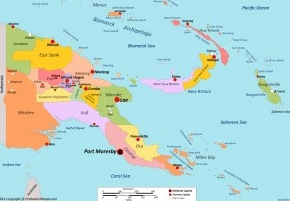
This week is the fiftieth anniversary of Independence in Papua New Guinea. Our family’s ten years in Port Moresby were extremely rewarding. We lived on the university campus from 1976 till 1986. The years after Independence were times of intense development. At the University, students told you they were proud of where they came from their [Ples] and their language [TokPles]. They were good enough to invite us to visit their region, no matter how far away they lived.
We met interesting people in town, and my best friend nicknamed me Mauswarra [the mouth that runs fast in Tok Pisin], in the same way as my family in France used to say I was Un moulin à paroles [a continuous word-windmill in French]. If I still lived in Port Moresby, I would now be called Bubu Mama [Grandma in Hiri Motu].
I am grateful for the warm welcome we received and how much we learned about a varied country with amazing landscapes of soaring mountains and seaside beaches. We had a Christmas lunch at a windy Ella Beach: lettuce leaves flew off, but we were able to eat the slices of cold turkey that remained on our plates. Two events at Idler’s Bay: a difficult one when our daughter was stung by a jelly fish; and a cheerful one when we attended David and Faith’s wedding. We also had a wonderful time at Gabba Gabba where the villagers gave us cool and large watermelons to eat, and their children played cricket with ours. We went to Yule Island on an outrigger canoe with eskis full of supermarket fruit and came back with fresh coconuts.
We were lucky to fly inland to Tapini and back safely in spite of the difficult airstrip; went to Bulolo and Wau to look at the remnants of gold mining and to the best market in the world at Goroka where I bought two of my favourite bilums [traditional string bags]. We also met with friendly people in stunning Madang and in the Island of Bougainville who always expressed the love of self-sufficiency. I cannot do justice to this country, and I regret not visiting other exciting places, like Milne Bay, the Sepik, the Western Highlands, East and West New Britain and Manus.
Papua New Guinea has in excess of 800 languages, Austronesian and Non-Austronesian which are able to do things that western linguists never thought possible. Through verb-stringing and other infixes languages focus on the manner of an action rather than on its timing, which is marked by adverbs. Besides liklik Tok Pisin and Hiri Motu bada (not really ‘much’!) I would have loved to learn languages from the Goilala people.
When we left UPNG students and staff organised a mumu, pig cooked in the ground with taro and vegetable wrapped in banana leaves as a farewell party.
On behalf of my family, it is my pleasure to wish all my friends and their wantoks [relatives], whom I cannot name here because I’d be sure to forget someone special, and in honour of those that have passed away, my absolute best for the 50th Independence Day Celebration on 16th September 2025.
( Thanks to Salvatore Adamo, Joe Dassin, Yves Duteil – Lyrics below)
A tune and a few words.
I hum a song or two.
I remember Tombe la neige
At the trail end of the nineteen sixties.
Adamo sings  of a lover’s distress
Emotions buried by steady snowfalls.

Next I  follow dreams and wishes  of those
who mastered obstacles
They reveal  their dynamic life
and a rhythm to sink all pessimism.
My voice attracted by Dassin’s
Taps to the refrain : Aux Champs Elysées.


I leap into action
with the energy and passion
of the adults and the parents
who relish their new lives
and will revel in inclusivity.
Prendre un enfant par la main
Walking with a child near you,
and holding their hands as a way
of 'giving them the confidence to walk'
Going with Duteil to find snow
And maybe the gift of optimism.
Salvatore Adamo – Tombe la neige Tombe la neige Tombe la neige Tu ne viendras pas ce soir Tombe la neige Et mon cœur s’habille de noir Ce soyeux cortège Tout en larmes blanches L’oiseau sur la branche Pleure le sortilège Tu ne viendras pas ce soir Me crie mon désespoir Mais tombe la neige
Tombe la neige Tu ne viendras pas ce soir Tombe la neige Tout est blanc de désespoir Triste certitude Le froid et l’absence Cet odieux silence Blanche solitude Tu ne viendras pas ce soir Me crie mon désespoir Mais tombe la neige Impassible manège
Joe Dassin – Aux Champs Elysées Je m’baladais sur l’avenue Le cœur ouvert à l’inconnu J’avais envie de dire bonjour À n’importe qui N’importe qui et ce fut toi Je t’ai dit n’importe quoi Il suffisait de te parler Pour t’apprivoiser
Aux Champs-Élysées Aux Champs-Élysées Au soleil, sous la pluie À midi ou à minuit Il y a tout c’que vous voulez Aux Champs-Élysées
Tu m’as dit “J’ai rendez-vous Dans un sous-sol, avec des fous” Qui vivent la guitare à la main Du soir au matin” Alors, je t’ai accompagnée On a chanté, on a dansé Et l’on n’a même pas pensé À s’embrasser
Yves Duteil – Prendre un enfant par la main Prendre un enfant par la main Pour l’emmener vers demain Pour lui donner la confiance en son pas Prendre un enfant pour un roi
Prendre un enfant dans ses bras Et pour la première fois Sécher ses larmes en étouffant de joie Prendre un enfant dans ses bras
Prendre un enfant par le cœur Pour soulager ses malheurs Tout doucement, sans parler, sans pudeur Prendre un enfant sur son cœur
Prendre un enfant dans ses bras Mais pour la première fois Verser des larmes en étouffant sa joie Prendre un enfant contre soi
Prendre un enfant par la main Et lui chanter des refrains Pour qu’il s’endorme à la tombée du jour Prendre un enfant par l’amour
Prendre un enfant comme il vient Et consoler ses chagrins Vivre sa vie des années, puis soudain Prendre un enfant par la main
En regardant tout au bout du chemin Prendre un enfant pour le sien
Is doing nothing better than mindfully focusing on one thing only?
But how do you ever find the elusive quality of nothingness ?
Silence doesn’t suffice because millions of thoughts
pile up on one another. Taking regular breaths
requires you  to move  and direct them
in and then out with deliberate action
Closing one’s eyes is simple but this
brings memories to front of mind.
Following musical rhythms
makes you stir. So this is
my answer: to achieve
nothing I’ll simply
spell out the word
N O T H I N G
or the word
R I E N.

Est-il plus facile de ne faire rien sans ne penser consciencieusement
qu’à une seule chose ?  Mais comment trouver la qualité élusive
d’arriver à ne rien faire ? Le silence ne suffit pas car il apporte
des millions d’idées qui se superposent les unes aux autres.
Si vous respirez de façon régulière vous devez diriger
votre souffle à monter et à descendre, donc c’est
un geste délibéré. Fermer les yeux est simple,
mais cela  apporte des souvenirs à l'esprit.
Suivre des rythmes musicaux vous force
à vous remuer. Donc ma réponse, pour
en venir à Rien, c’est simplement
d’épeler le mot R I E N, ou
le mot N O T H I N G.






 Yayi's Paroles
You must be logged in to post a comment.