

Why Roebourne is my favourite small town in Australia
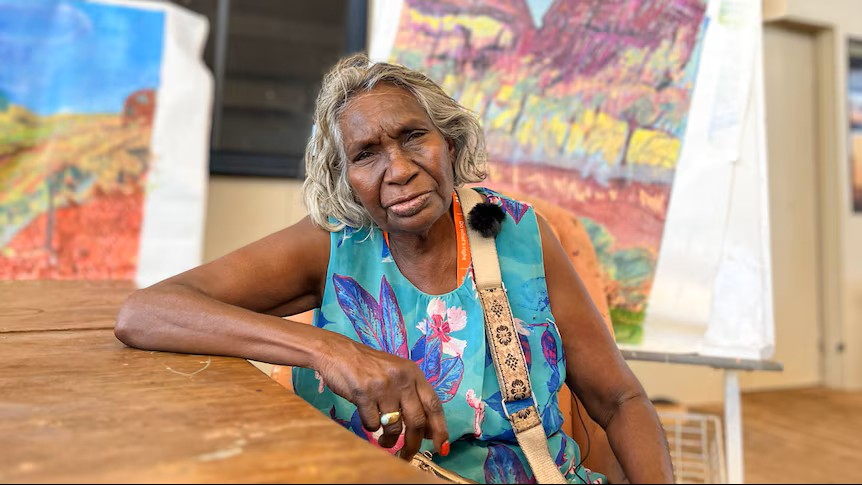
In March 2026 Yindjibarndi Elder Wendy Hubert and Juluwarlu Art Cooperation
travelled 5,000 km by road from Roebourne to Sydney as guests of the Sydney Biennale.
Links:
- Indigenous artworks taken on 5,000km road trip from the Pilbara to Biennale of Sydney - ABC News
- Wendy Hubert | 25th Biennale | Rememory | SBS On Demand

Roebourne [Ieramugadu, in Ngarluma; population 981-2016 census ],
is located within the City of Karratha at 1,563 from Perth (West Australia)
From 1930-1950 it was a non-Indigenous administrative centre.
The Yindjibarndi, Kuruma, Yaburrara, Marthudunera, Banjima, and
Kariyarra people were gathered to camps and reserves with controls and
curfews placed on Aboriginal people’s movements to, from, and within
the town. Later, iron-ore mining enterprises constructed company towns
and moved people from the crowded surrounds into Roebourne in the
1960s.

Exile and the Kingdom www.sbs.com.au/ondemand/tv-series/exile-and-the-kingdom
an award-winning documentary captured the spirit of the town, narrated by
a late elder with the Yindjibarndi, Ngarluma, Banyjima and Kurrama people
of Roebourne. It recounts the experiences of the Aboriginal community
from pre-colonial times to the 1990s.

Community centres in Roebourne include a Health Centre, an Aged
people’s home, a library, a primary and secondary school. It holds cultural
centres like the Ngarluma Yindjibarndi Foundation Ltd, and the media
station https://www.ngaardamedia.com.au/ngaarda-radio. Preserving the
Yindjibarndi history & culture Juluwarlu https://juluwarlu.com.au/ documents
the ngurra (the land) with the help of artist like Yindjibarndi Elder Wendy
Hubert while teacher, linguist and artist, Allery Sandy, runs the art centre
‘Yinjaa-Barni (Working Together)’  (www.yinjaa-barni.com.au)

‘Wanthiwa’ is the Yindjibarndi  ‘Welcome’ word I heard when I walked
down the streets in Roebourne. I met the ‘strong’ women and men that
made the town real, similar to when I lived in France and people always
greeted each other. I enjoyed walking alongside families sitting on the
 verandah. The town residents also walked from one house to the other
to consult with one another, as against those who walk for exercise,
which most of us do in Australia, without talking to anyone. I have fond
memories of families sitting on the verandah. This contrasted with life
in Karratha where I lived, driving from one spot to the next, usually in
large 4 x 4 vehicles and only seemed to speak to people in shops or
offices. I worked as the Roebourne Prison Education Officer for three
years where a majority of Indigenous people spent spells of months or
years as minimum priority prisoners, often for fine overloads or
breaching a driving licence.  There I ran the Education Centre
where prisoners used their time catch up with their education which
had been interrupted.

Community gatherings I later worked for the local shire and organised
exchanges between the Indigenous community and the multicultural
residents of  the local towns.  We shared picnics with a taste of kangaroo
tails cooked in the ashes. A gathering is held in early July for all the older
Aboriginal people to celebrate their birthdays, given that their birthdates
were never registered.

In Australia’s massive country, this compact town will always have a place
in my heart.
Roebourne , ma petite ville préférée en Australie
En mars 2026, Wendy Hubert, aînée Yindjibarndi, et Juluwarlu Art
Coopération ont parcouru 5 000 km par la route, de Roebourne à
Sydney, en tant qu’invités de la Biennale de Sydney. Links below:
Indigenous artworks taken on 5,000km road trip from the Pilbara to Biennale of Sydney - ABC News
Wendy Hubert | 25th Biennale | Rememory | SBS On Demand

Roebourne, dont le nom est Ieramagadu dans la langue Ngalurma avait
une population de 981 habitants au recensement de 2016, est située dans
l’agglomération de Karratha à 1563 km de Perth (capitale de l’Australie
Occidentale). De 1930 à 1950 ce fut un centre administratif non-
Autochtone. Les peuples Yindjibarndi, Kuruma, Yaburrara,
Marthudunera, Banjima et Kariyarra furent regroupés dans des camps
et des réserves. Des contrôles et des couvre-feux furent imposés aux
Aborigènes quant à leurs déplacements à destination, en provenance et
à l'intérieur de la ville. Plus tard, dans les années 1960, des entreprises
minières de minerai de fer construisirent des villes ouvrières et
déplacèrent les populations d’un environnement surpeuplé vers
Roebourne.

Exile and the Kingdom www.sbs.com.au/ondemand/tv-series/exile-and-the-kingdom
un documentaire primé, a capturé l’esprit de la ville, narré par un ancien
aujourd’hui disparu des peuples Yindjibarndi, Ngarluma, Banyjima et
Kurrama de Roebourne. Il relate l’histoire d’une communauté aborigène,
des temps précoloniaux aux années 1990.

Les Centres de communauté de Roebourne consistent d’une clinique,
d’un centre pour personnes âgées, d’une bibliothèque et une école
primaire et secondaire. La ville contient la Fondation Ngarluma
Yindjibarndi Ltd et une media https://www.ngaardamedia.com.au/ngaarda-radio
Le groupe de Juluwarlu https://juluwarlu.com.au/ se concentre sur l’histoire
et la culture documente le ngurra (la terre natale) avec l’aide d’artistes
comme l’aînée Yindjibarndi Wendy Hubert. Un autre studio d’art  le
Yinjaa-Barni (Le Travail Ensemble) www.yinjaa-barni.com.au  est tenu
par l’aînée Yindjibarndi Allery Sandy, institutrice, linguiste et artiste.

Wanthiwa est le mot Yindjibarndi pour «Bienvenue» que j’entendais en
passant dans les rues de Roebourne. Je fis connaissance de femmes ‘fortes’
et de leurs partenaires qui rendent la ville vraiment réelle, me rappelant
ma vie en France quand les gens se saluaient toujours. J’aimais bien voir
toutes les familles assises sur leurs vérandas lorsque je passais dans la rue.
Là les résidents allaient d’une maison à l’autre pour discuter entre eux,
ce qui était le contraire de ceux qui se promènent pour faire de l’exercice,
comme nous le faisons tous en Australie, sans jamais parler à personne.
Ceci était un contraste avec la vie à Karratha où j’habitais, et où on
conduisait d’un endroit à l’autre, le plus souvent dans de gros véhicules
4x4 et où on ne parlait aux gens que dans les bureaux ou les magasins.
Je travaillais pendant trois ans dans le centre d’éducation de la Prison
Régionale de Roebourne où il y avait une majorité de prisonniers
Indigènes qui étaient condamnés à une peine minimale de quelques
mois ou années, soit pour des amendes accumulées ou pour infractions
au permis de conduite. Là j’organisais le Centre d’Education et les
prisonniers utilisaient ce temps-là pour se rattraper sur leurs études
qui avaient été interrompues.

Réunions entre groupes communautaires J’ai travaillé ensuite pour
la municipalité et facilité les échanges entre groupes Indigènes et
groupes multiculturels de la région. Nous avons fait des pique-niques
et gouté 'la queue de kangourou cuite dans les cendres'. Tous les ans,
début juillet, la communauté organise une journée pour célébrer
l’anniversaire des personnes Aborigènes âgées car leurs naissances
n’avaient pas été enregistrés.

Dans l'immense pays qu'est l'Australie, cette petite ville aura toujours
une place dans mon cœur.


You must be logged in to post a comment.