Words and Paroles: a monthly bilingual (En-Fr) blog and other vignettes
Author: Yayi-Australie
I am a French-born Australian linguist who loves writing about multicultural experiences. Taught English in Zambia and Papua New Guinea, gained a Doctorate with UPNG. In Western Australia I worked with migrants and Indigenous communities in Kalgoorlie and Roebourne. In charge of Amnesty International WA, then moved to Adelaide. Short-listed by The Human Rights Commission for the Literature NF Award for the anthology I edited with the Multicultural Writers Association of Australia, I later published my memoir. Volunteered with the Writers Centre, became active with PEN.
At a time when I had pain down my back, and itchy spots came on my leg, which hassled me down the seams of my jeans. Revelation! It was shingles.
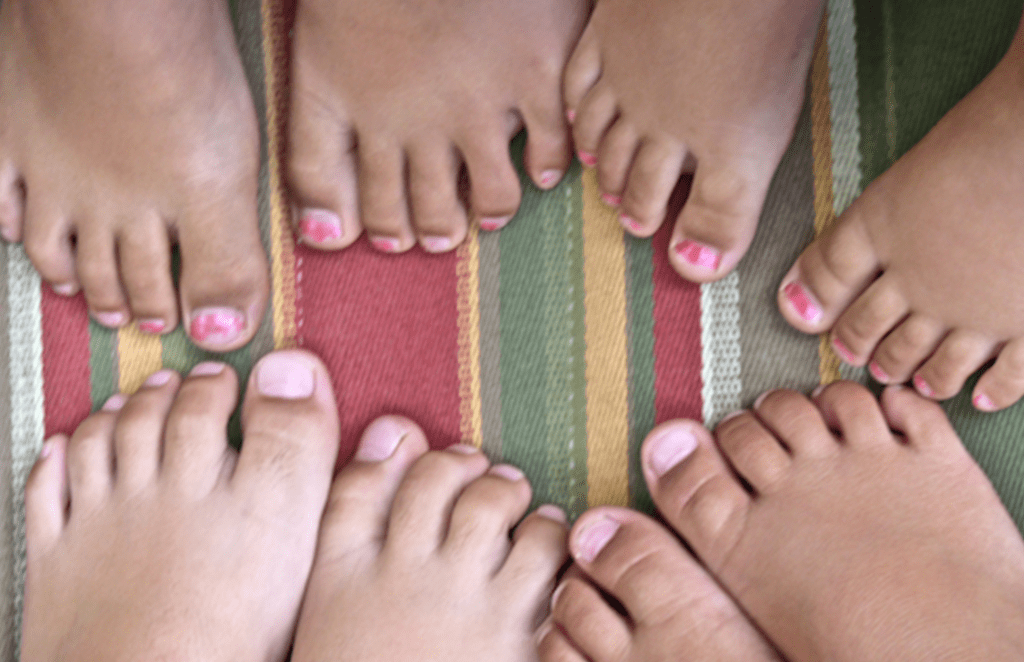
Toes close together, with no will to move, and my leg dragged heavy as lead, in the middle of the night in a bath, I’d hum tunes to my poor sore toes.
Shuffling and limping was the only way I could achieve going places. Ensconced in thick socks, my toes stayed stone cold, My world was quite amiss.
Mixed with sciatica, shingles’ trouble. Two of my toes are lifeless now. One year gone by, and I'm not antivax, a jab to save my other toes.
Une ballade sur mon zona irritant
Un jour ayant des douleurs dans le dos des boutons me piquèrent la jambe tout le long de la couture de mes jeans. Révélation, c’était l’ zona !
Mes orteils sans volonté, compressés, et la jambe trainant comme du plomb, la nuit, les doigts d’pied plongés dans le bain je leur chantonnai des comptines.
Tout en boîtant et en trainant les pieds j’arrivai à me déplacer. Mes orteils enfoncés dans d’énormes chaussettes restèrent froides. Et ma vie clochait.
Sciatique liée au zona m’accablèrent, Deux de mes orteils ont péri. Et cette année, n’étant pas antivax, piqûre! Pour qu’il m’reste d’autres orteils !
As soon as I left home, I grasped a life of change riding a motorbike and smoking cigarettes to counter my parents’ humdrum daily lifestyle.
A milestone came for me the year of moon landing, I took one giant step, went to Mwinilunga. In North Western Zambia, at the Zambezi source, new folk shared food with me.
No electricity. We burnt wood in the stove, kerosene in the lamps and had a few candles Often left stains of wax on students’ homework books.
At open air concerts, villagers came to sing, to booming drums we danced the Congolese Rumba. I even joined when eight months’ pregnant.
No newspapers in town. A radio and batteries. The sun shone over us its healthy radiant heat. At night, the stars sparkled.
Traces of defiance and of independence are still burning in me. I’ve danced myself away at cultural events, backed First Nations’ requests that their voices be heard.
Yet I’m still waiting to see sparkling stars enlighten the modern world I live in. Suburbia be damned!
Comme je voudrais encore vivre en marge de ce monde
Quand j’ai quitté mes parents j’ai vécu une vie différente Circulant en moto et fumant des cigarettes. Pour contre-carrer leur train-train habituel .
Une étape importante est arrivée pour moi l'année de l'alunissage, j'ai fait un pas géant, Partie pour la Zambie dans le Nord-Ouest Là, à Mwinilunga, à la source du Zambèze, de nouveaux amis partageaient leur nourriture avec moi.
Pas d’électricité. Chez nous, un four à bois, une lampe au kérosène, quelques bougies. Souvent on laissait des tâches de cire en corrigeant les cahiers des élèves.
Les concerts étaient en plein-air. les habitants venaient chanter, Nous dansions, au bruit de tambours sonores, la Rumba Congolaise à laquelle j’ai osé me joindre, bien qu’enceinte de huit mois.
Pas de journaux en ville. Une radio et des piles. Le soleil chaleureux chauffait avec radiance. La nuit, toutes les étoiles étincelaient.
Des traces d’indépendance et de défi brûlent encore en moi. J’ai dansé comme une folle Du temps de réunions interculturelles. J’ai soutenu les requêtes des Premières Nations qui voulaient qu’on écoute leurs voix et leurs paroles.
Mais j’attends encore voir un scintillement d’ étoiles éclairer le monde moderne que j’habite. Maudite soit la vie en banlieue !
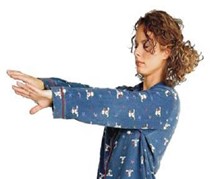
I have an imaginary house in my dreams. It is a pleasant house with many rooms. It is in a city where I once lived but not in the same street. There I speak to all the neighbours who seem to know my family well. This morning when I woke up in that house I wanted to go to the bathroom. I was surprised to find the door opened. I also could smell coffee. As I opened my eyes I was in my present day real lounge. I saw my husband and said ‘ I was looking for the bathroom.’ As I turned around to go to my real bathroom I heard him say ‘Sleepwalked again?’
Somnambule
J'ai une maison imaginaire dans mes rêves. C'est une maison agréable avec de nombreuses pièces. Elle est dans une ville où j'ai vécu, mais pas dans la même rue. Je parle à tous les voisins qui semblent bien connaître ma famille. Ce matin quand je me suis réveillée dans cette maison-là, je voulais aller à la salle de bains. J’ai été surprise de trouver la porte ouverte. J’ai aussi senti l' odeur du café. Ouvrant les yeux j’ai découvert que j'étais dans le salon de ma vraie maison. Voyant mon mari je lui dis ‘Je cherchais la salle de bains.’ Je faisais demi-tour sur ma vraie salle de bains quand il a dit 'Encore somnambule ?’
Jacques Brel: Quand on n’a que l’amour. Leo Ferre: Paris Canaille Georges Brassens: L’ Auvergnat. Elle est a toi cette chanson
French Chansons /On Chante
I was supposed to read a book, Yet couldn’t even read the news I was better, but still quite weak. After covid, the damned shingles.
Eyes closed, I played the olden tunes of my adolescence in France Some said it must be nostalgia, I called it French songs on my phone.
Ils chantent eux, moi je fredonne, et je murmure une mélodie émettant l’écho du terroir, qui me parle d’un lointain chez moi.
Piaf et sa Môme lance les chanteurs dont les paroles, plus que les airs, sont restées, ancrées dans ma peau.
Aznavour s’y Voyait Déjà, Mais Jacques Brel n’avait Que l’Amour, Brassens nous donna Cette Chanson Jean Ferrat chanta sa Montagne, Leo Ferré Paris Canaille.
Et moi j’entonne Le Se Canto, l’hymne occitan de mon pays Qui est le mien. Well, used to be.
Quand on n’a que l’amour
À s’offrir en partage Au jour du grand voyage Qu’est notre grand amour Quand on n’a que l’amour Mon amour, toi et moi Pour qu’éclatent de joie Chaque heure et chaque jour … Quand on n’a que l’amour Pour parler aux canons Et rien qu’une chanson Pour convaincre un tambour Alors sans avoir rien Que la force d’aimer Nous aurons dans nos mains Amis le monde entier
Chanson pour l’Auvergnat
Elle est à toi cette chanson Toi l’Auvergnat qui, sans façon M’as donné quatre bouts de bois Quand dans ma vie il faisait froid Toi qui m’as donné du feu quand Les croquantes et les croquants Tous les gens bien intentionnés M’avaient fermé la porte au nez Ce n’était rien qu’un feu de bois Mais il m’avait chauffé le corps Et dans mon âme, il brûle encore À la manière d’un feu de joie Toi, l’Auvergnat quand tu mourras Quand le croque-mort t’emportera Qu’il te conduise à travers ciel Au père éternel …
Elle est à toi cette chanson Toi l’étranger qui, sans façon D’un air malheureux m’as souri Lorsque les gendarmes m’ont pris Toi qui n’as pas applaudi quand Les croquantes et les croquants Tous les gens bien intentionnés Riaient de me voir emmené Ce n’était rien qu’un peu de miel Mais il m’avait chauffé le corps Et dans mon âme, il brûle encore À la manière d’un grand soleil Toi, l’Étranger quand tu mourras Quand le croque-mort t’emportera Qu’il te conduise à travers ciel Au père éternel
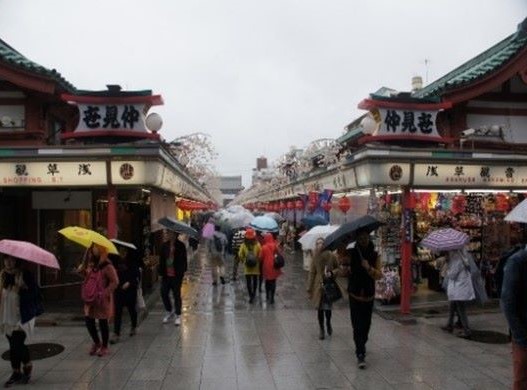
I try not to walk on the crack but there are other lines I care not to cross. Yesterday, it was raining and I was making my way from one side of the street to a group of shops without crossing anyone’s path. I also ignored the shine, the sounds and the glistening that are only there as a magnet.
One glance at people around me and I try and guess some of their intents. I first walked alongside a mother and her son, who seemed happy, chatting on their way to the ‘Raisin’ [Ray’s in] café that people go to because they like its name. Next a woman in a well-oiled wheelchair smiled at me. We shared a peaceful look.
I slipped behind her at the time when a youth, in a casual T-shirt, who appeared in a great rush, disappeared in the entrance of the store I had targeted.
One extra step took me into its doorway where a man, with a cap on, stared at his mobile allowing me time to close my umbrella.
This pleased me because I had achieved to reach my favourite store without disturbing any one’s space.
Navigation consciente, un jour de pluie, en ville
Je tente de ne pas empiéter le chemin des personnes autour de moi. Hier il pleuvait. J’ai traversé la rue pour aller vers un groupe de magasins sans croiser personne et en ignorant le magnétisme des décors étincelants et des sons bruyants.
D’un coup d’œil sur les gens autour de moi j’essaie de deviner un peu leurs intentions. J'ai d'abord marché aux côtés d'une mère et de son fils, qui semblaient heureux et parlaient d’aller ‘Aux Deux Nids’ [Oh, De-nis] où les gens viennent prendre un café parce qu’ils aiment ce nom. Puis une femme dans un fauteuil roulant bien huilé, m’a souri et elle a échangé avec moi un regard serein.
Je me suis glissée derrière elle au moment où un jeune homme en T-shirt décontracté, qui semblait très pressé, a disparu dans l'embrasure du magasin vers lequel je me dirigeais.
Un pas de plus m'a conduit à son entrée où un homme à casquette regardait son portable. Ceci me donna le temps de fermer mon parapluie.
Quel plaisir pour moi d’avoir réussi à atteindre mon magasin préféré sans avoir usurpé l’espace d’aucun autour de moi.
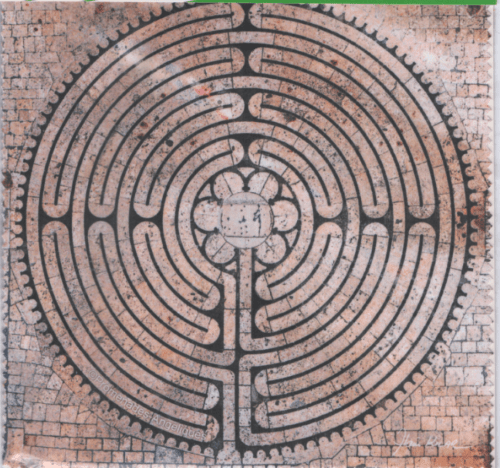
Opening the window, I saw a garden reminding me of labyrinths its paths drawn towards the interior. Little by little, my eyes followed the universal curves of nature, and the spiralling diminished. These meanderings had the effect of me becoming lighter and I floated past the window. At the centre of this virtual flight, I saw what seemed like a sunflower. I took a photo this exotic garden laying there in the heart of France. What an amazing vision in Chartres! Falling to my bed, I fell into a peaceful serene sleep.
Spirale et esprit de sérénité
En ouvrant ma fenêtre je vis un jardin qui me rappelait un labyrinthe dont les pistes partaient sur l’intérieur. Petit à petit, mes yeux qui suivaient ces courbes universelles de la nature virent la spirale s’atténuer. Tous ces colimaçons eurent l’effet de me rendre plus légère en me faisant flotter du haut de ma fenêtre. Au bout de ce vol virtuel je fis face à une fleur qui ressemblait a un tournesol. Quelle vue inouïe de ma chambre à Chartres! Je pris une photo du jardin exotique situé en plein cœur de France. Je me retournai vers le lit et la je fus prise d’un sommeil pacifique.
With luck I met Jean-Marie Tjibaou when I translated his speeches during his visit to PNG. In spite or because of being a reasonable leader he was assassinated (1989). He negotiated referendums for Kanak Independence. Good to see his legacy is respected with pride.
I’ve had to leave my confort zone and check on my own biases. It’s when we are short of information that we have hangups. Our mind opens to the people around us when we explore our world.
When you reach 8 times Ten, you can at last smile and laugh, with no concerns or worries in spite of a sore foot, hip or head. It’s quite easy: lean slightly back and you end up standing quite straight.
Quatre Vingt Mots
Quand on a '4xVins', on peut enfin rire et sourire sans trop d’inquiétude, cela malgré son mal au pied, mal à la hanche ou à la tête. Il suffit de se pencher en arrière et on se tient droit!
Is doing nothing better than mindfully focusing on one thing only?
But how do you ever find the elusive quality of nothingness ?
Silence doesn’t suffice because millions of thoughts
pile up on one another. Taking regular breaths
requires you  to move  and direct them
in and then out with deliberate action
Closing one’s eyes is simple but this
brings memories to front of mind.
Following musical rhythms
makes you stir. So this is
my answer: to achieve
nothing I’ll simply
spell out the word
N O T H I N G
or the word
R I E N.

Est-il plus facile de ne faire rien sans ne penser consciencieusement
qu’à une seule chose ?  Mais comment trouver la qualité élusive
d’arriver à ne rien faire ? Le silence ne suffit pas car il apporte
des millions d’idées qui se superposent les unes aux autres.
Si vous respirez de façon régulière vous devez diriger
votre souffle à monter et à descendre, donc c’est
un geste délibéré. Fermer les yeux est simple,
mais cela  apporte des souvenirs à l'esprit.
Suivre des rythmes musicaux vous force
à vous remuer. Donc ma réponse, pour
en venir à Rien, c’est simplement
d’épeler le mot R I E N, ou
le mot N O T H I N G.
Hi Martin. I’m Annie, social worker to-be. After last week’s request
for a visit,  I have come in to see if I can read to you, watch
films with you, or if you want, practise skills like paper
quilling, model building or animal tracking. This list
gives you the selection of topics and a choice of
our volunteers from the community centre.
You do not have to agree.  You make
the decision, select the activity,
the time and you tell me,
It is totally your call:
Yes, No or  Maybe.
Roland: I say yes.
How about
dancing a
Tango
now?
Bonjour Martin.  Moi
je suis Annie et je suis
une aide-assistante sociale.
La semaine dernière j’ai offert
de venir vous voir pour expliquer
ce que fait notre groupe. Je demande
si je pourrais lire avec vous, ou regarder
des films ensemble, si vous voulez apprendre
à faire des objets en papier, à construire des modèles
ou à suivre les traces d’animaux. Voici une liste de sujets
à sélectionner ainsi que celle des bénévoles de notre centre
urbain. Vous n’êtes pas obligé d’accepter, c’est vous qui prenez
la décision.  A vous de choisir l’activité et l’horaire, dites-le-moi
et vous aurez le dernier mot, absolument.  Oui, Non, ou Peut-être.
Roland :  Je vous dis oui.   J’aimerais danser un  Tango  tout de suite.
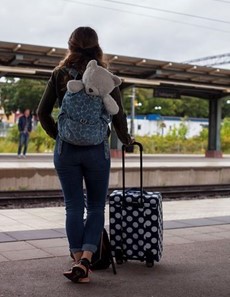
The first time I leave home
The year is 1955. My mother gives me a black and white suitcase
and gives me bread and salami for the trip. I'm taking the train
to England. It passes through Paris to Le Havre. I put the salami
in my suitcase because I'm not hungry. With my friends and a
teacher we are going to Bristol by night ferry. In Southampton,
we take a dusty old train to Bristol station. I spend a month with
a nice family. But in the evening I feel homesick when I open
my suitcase which smells of salami.

La première fois que je quitte la maison
Nous sommes en 1955.  Ma mère m'offre une valise noire et
blanche et me donne du pain et du saucisson pour le voyage.
Je prends le train pour l’Angleterre. Il va au Havre par Paris.
Je range le saucisson dans ma valise car je n’ai pas faim.  Avec
mes amies et une professeur nous allons à Bristol par ferry de
nuit. A Southampton,  nous prenons un vieux train poussiéreux
pour nous rendre en gare de Bristol. Je passe un mois avec une
famille sympathique. Mais le soir j’ai le mal du pays en ouvrant
 ma valise qui sent au saucisson.

La primera vez que salgo de casa
Es el año 1955. Mi madre me regala una maleta blanca y negra
y me da pan y salchichas para el viaje.  Voy a tomar el tren
a Inglaterra.  Pasa por París y Le Havre.  Guardo la salchicha
en mi maleta porque no tengo hambre.  Con mis amigos
y una profesora vamos a Bristol en ferry nocturno.  En
Southampton, tomamos un viejo tren polvoriento hasta
la estación de Bristol.  Paso un mes con una familia agradable.
Pero por la noche siento nostalgia cuando abro mi maleta
que huele a salchicha.


















You must be logged in to post a comment.