Featured

L’Encantada’ de Nadau: Lyrics in Occitan, French and English

Lyrics below in Occitan, French and English
L’Encantada- a song by Nadau in Occitan

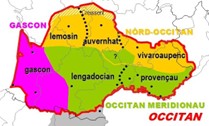
Occitan, lenga d'òc, is a Romance language spoken in a third of France across the
south also called Occitanie, Italy's Occitan Valleys, and Spain’s Val d'Aran. It is the
language of the people who used òc to say ‘yes’. (Northern France used to say 'oïl '.)

The language of medieval troubadours, it is distinct from French, sharing closer
ties to Catalan. It’s an endangered language, with six major dialects: Gascon-Béarn,
Provençal-Nice, Languedocien (often used as the basis for the standard form),
Limousin - North Dordogne, Auvergnat and Provençal Alpin.


It was my grandparents’ language. Both my parents spoke fluent Occitan-Limousin
with their parents in the North Dordogne region of France, also called the ‘Green
Périgord ’. I only spoke some phrases of it, but I understood instructions given to
me (and had to follow them!) I remember older Occitan songs especially Se Canto.
Thanks to Nadau’s compositions, concerts and revival (www.nadau.com) of the
Gascon-Béarn language, the tone and vitality of my grandparents and parents'
voices are revived. I am now re-learning Occitan online from Australia.

L’Encantada, The Enchanted, is the most famous Occitan (Béarn) song performed
by the Nadau Group [ https://nadau.com/ ], which although composed relatively
late by Nadau, as the journal Le Point tells us (02.06.2017) is now interpreted as
‘traditional’. Mike Bresson (fb) tells us that L’Encantada is 'a hymn to love, as in love
at first sight.’

Follow the Lyrics below:


L’Encantada- chanson de Nadau en Occitan

L'occitan est une langue romane (lenga d'òc) parlée dans le tiers sud de la France,
aussi appelée Occitanie, ainsi que dans certaines vallées d'Italie et le Val d'Aran en
Espagne. C’est la langue qui utilise òc pour dire 'oui'. Dans le Nord on disait 'oi'.

Connue comme la langue des troubadours du Moyen-Age, elle est différente du
Français et très proche du Catalan. C’est une langue en danger, elle se divise en six
dialectes définis (Gascon-Béarn, Provençal-Nice, Languedocien (souvent la base
d'un standard), Limousin - Nord Dordogne, Auvergnat et Provençal Alpin.


C'était la langue de mes grands-parents en Dordogne du Nord qui s'appelle aussi
le Périgord Vert . Mes parents parlaient couramment à leurs parents en Occitan.
Je n'en parlais que quelques phrases mais je comprenais bien les instructions qu’on
me donnait (et j’étais obligée de les suivre !) Je me souviens des chansons en Occitan
surtout Se Canto. Grâce aux compositions et concerts de Nadau (www.nadau.com) et
de son relancement du Gascon-Béarnais, je revis le ton et la vitalité de la voix de mes
grandparents et parents et je réapprends l’Occitan sur l’internet depuis l'Australie.

L’Encantada est une chanson en Occitan (Béarnais) la plus célèbre du groupe Nadau
https://nadau.com/ bien que composée relativement tard, comme nous dit la revue
Le Point (02.06.2017), elle est interprétée comme ‘traditionnelle’. Mike Bresson nous
dit (fb) « L’Encantada est un hymne à l’amour du genre ‘coup de foudre.»

Paroles ci-dessous :
https://www.nadau.com/paroles/1725#


L'ENCANTADA -Occitan

Patapim,Patapam,
Non sèi d’on ei sortida,
Non m’a pas briga espiat,
E m’èi pergut suu pic,
E la hami e la set.
Patapim, Patapam,


Non sèi çò qui m’arriba,
E shens nada pieitat,
Que’n va lo son camin,
Que camina tot dret.
Non sèi pas lo son nom,
Tà jo qu’ei l’Encantada,
Tà la véder passar,
Jo que’m hiqui ací,
Tot matin a l’argueit,


Non sèi pas lo son nom,
Tà jo qu’ei l’Encantada,
Non hèi pas qu’i pensar
E la nueit e lo dia
E lo dia e la nueit.
Jo tostemps qu’avi sabut
E díser non e díser adiu,


Jo jamei n’avi volut,
Jamei pregar òmi ni Diu,
Ara qu’ei plegat lo jolh,
Dehens la gleisa capbaishat,
Tà mendicar çò qui voi,
Aledar au son costat.


De la tèrra o deu cèu,
Tau com la periclada,

E tot a capvirat,
Arren non serà mei,

Non jamei com avans,
Ni lo hred de la nèu,
Ni lo verd de la prada,

Ni lo cant d’un mainat,
Ni l’anar deu sorelh

Qui hè córrer los ans.
Non sèi pas lo son nom,


Tà jo qu’ei l’Encantada,
E si n’ei pas tà uei,
Tà doman qu’ei segur,
Que l’anirèi parlar,
Non sèi pas lo son nom,
Tà jo qu’ei l’Encantada,
Doman que’u diserèi,
Dinca ací qu’èi viscut
Sonque tà v’encontrar.
https://www.nadau.com/paroles/1725#


L'ENCHANTĖE -Français

Patapim, Patapam,
Je ne sais d’où elle est sortie,
Elle ne m’a même pas regardé,
Et j’ai perdu tout de suite
Et la faim et la soif.
Patapim, Patapam,


Je ne sais ce qui m’arrive,
Et sans aucune pitié,
Elle va son chemin,
Elle chemine tout droit,
Je ne sais pas son nom,
Pour moi, c’est l’Enchantée,
Pour la voir passer,
Moi, je me mets ici,
Tous les matins à la guetter,


Je ne sais pas son nom,
Pour moi, c’est l’Enchantée,
Je ne fais qu’y penser
Et la nuit et le jour
Et le jour et la nuit.
Moi, toujours j’avais su,
Et dire non et dire adieu,


Moi, jamais je n’avais voulu,
Jamais prier homme ni Dieu,
Maintenant j’ai plié le genou,
Dans l’église, la tête baissée,
Pour mendier ce que je veux
Respirer à côté d’elle.


De la terre ou du ciel,
Comme la foudre,

Et tout a chaviré,
Rien ne sera plus,

Non, jamais comme avant,
Ni le froid de la neige
Ni le vert de la prairie

Ni le chant d'un enfant
Ni la marche du soleil

Qui fait courir les années.
Je ne sais pas son nom,


Pour moi, c’est l’Enchantée,
Et si ce n’est pas aujourd’hui,
Demain c’est sûr,
J’irai lui parler,
Je ne sais pas son nom,
Pour moi, c’est l’Enchantée,
Demain je lui dirai,
Je n’ai vécu jusqu’ici
Que pour vous rencontrer
https://lyricstranslate.com/en/lencantada-enchanted.html


THE ENCHANTED -Engl

Patapim, patapam
I don't know where she came from
She never took a glance at me
I lost her right away
Then came hunger & thirst
Patapim, Patapam,

I don't know what's happening to me
And without any mercy
She walked away
She went straight ahead
I don't know what's her name
For me, she's the Enchanted
To see her pass by,
I'd put myself there
Every morning I 'd watch

I don't know what's her name
For me, she's the Enchanted
I'd just think about her
And all night and all day
And all day and all night
I 'd always known about her
&she said no &said goodbye

I had never wanted to
I never prayed to any man or to God
Now I am on my knees
Inside the church, bowing down
To beg for what I want
Breathing right next to her


From the earth or the skies
It struck like lightning
And everything turned over
Nothing will be ever like this anymore
No never like this before
Not even the coldness of snow
Not even the greenness of the fields
Not even a song of a child
Not even the marching of the sun
That would run through the years
I don't know what's her name

For me, she is the Enchanted
And if it's not today
Then tomorrow, for sure
I'll soon talk to her
I don't know what's her name
For me, she's the Enchanted
Tomorrow, I'll tell her
That I have lived long enough
Just to meet you


Happy 2026 in 26 Languages to family & friends

Featured

                          HAPPY  ‘26  WISHES IN 26 LANGUAGES
from Anne-Marie
For practical reasons, I chose to use the Latin alphabet.
I send my warm wishes (shall I say, I hope) for everyone to enjoy a
peaceful life in 2026. As we all know, cultures and calendars show
differences from one another. In fact, my ‘western’ concept of wishing Happy New Year can be conveyed with different phrases around the
world. I’ve tried to transcribe the greetings’ literal translations, but
please let me know of any corrections or alternatives.

1 Arabic sanah jadīdah sa’ida [Happy New Year]
2 Basque Urte berri on [Happy New Year]
3 Chinese Cantonese gùng héi faat chōi[Wishing you prosperity, wealth] /Mandarin gōngxǐ fācái [Happiness and Prosperity] Chinese New Year17 Feb
4 Ci Lunda Shikenu mwani[Welcome, Are you good?]
5 Finnish Hyvää uutta vuotta [Good New Year]
6 French Bonne Année/Occitan: Bona annada [Good Year]
7 German Frohes neues Jahr [Happy New Year]
8 Greek Eftychisméno to néo étos [Happy New Year]
9 Hebrew Shana Tova u-Metukah [Good Sweet Year]
Jewish New Year 12 Sept
10 Hindi Nav Varsh Mangalmay Ho [May the New Year be Auspicious)]
11 Hiri Motu Tenkyu long bung tumora [Thank you for Tomorrow]
12 Irish Gaelic Athbhliain faoi mhaise duit [Prosperous New Year]
13 Italian Felice anno nuovo [Happy New Year]
14 Kaurna Niina Marni [Hello/Are you good]
15 Indonesian Selamat tahun baru [Greetings for the New Year]
16 Maori Ngā mihi o te tau hou [Greetings/Thanks for the New Year]
17 Ndebele Umnyaka omuhle [Beautiful Year]
18 Polish Szczęśliwego Nowego Roku [Happy New Year] Used for
Christmas and the New Year Season
19 Romanian Un An Nou Fericit [A New Year happy]
20 Scots Lang may yer lum reek [Long may your chimney smoke]
21 Spanish Feliz año nuevo [Happy New Year]
22 Swedish Gott nytt år [Good New Year]
23 Tok Pisin Hapi Niu Yia [Happy New Year]
24 Vietnamese Chúc mừng năm mới [Congratulations on the year new]
25 Wangkatja Palya [Hi, Good]/Ngaanyatjarra Pitjantjatjara Yankunytjatjara
Palya nyinama[Stay good, sitting down] Courtesy NPY Women's Council
26 Yindjibarndi: Wanthiwa [Welcome, Are you good?]

All errors are mine. Please feel free to correct them, write a comment, or like.

En Français
Pour des raisons de facilité, j’ai choisi d’utiliser l’alphabet Romain.

Je souhaite (ou plutôt j’espère) que chacun puisse vivre une année 2026 paisible. Nous savons que les cultures et les calendriers présentent des
différences. En effet, ma conception ‘occidentale’ des vœux de bonne
année peut être exprimée de différentes manières à travers le monde.
J’ai tenté de transcrire la traduction littérale des vœux, mais n'hésitez
pas à me faire part de toute correction ou suggestion.
Je me porte responsable de toute erreur. N’hésitez pas à me faire part de vos corrections et suggestions. Faites aussi un commentaire ou un "Like’.

Se Canto – The Occitan hymn of Southern France

Featured

The ‘Se Canto/Se Canta‘ is a hymn in the Occitan language which

is used in the majority of Southern France.

https://en.wikipedia.org/wiki/Occitan_language

This traditional song was written in the 14th century probably

by Gaston Phébus, Comte de Foix et Seigneur du Béarn. It

became popular and is used, with minor variants, across most

of Southern France as a regional hymn. It is sung in the Béarn

and Gascony areas by Nadau, who has also brought to life many

other songs in Occitan. He performed this at the Olympia in 2000.

Below is the version my grandparents would sing in the 1950s, in the

Dordogne. It’s sung in the Limousin to Toulouse, further East to the region

of Provence and South to the Pyrénées.

OCCITAN

Dejós ma fenèstra,
I a un aucelon, Tota la nueit canta,
Canta sa cançon

Chorus

Se canta, que cante,
Canta pas per ieu,
Canta per ma mia,
Qu’es al luènh de ieu.

Aquelas montanhas,
Que tan nautas son,
M’empachan de veire,
Mas amors ont son.

Baissatz-vos, montanhas,
Planas, auçatz-vos,
Per que pòsca veire,
Mas amors ont son.

Aquelas montanhas,
Tant s’abaissaràn,
Que mas amoretas,
Se raprocharàn.

ENGLISH

Outside my window,
There is a little bird
It sings all night
It sings its song

Chorus

 If it sings, let it sing,
It’s not singing for me,
It sings for my love
Who’s far away from me 

Those mountains
That are so high
Keep me from seeing
Where are my love.

Lay down, o mountains,
Rise up, o plains,
So I may see
Where are my love

Those mountains
Will lay down so low
That my dear love
Will come closer.

FRANÇAIS

Sous ma fenêtre
Il y a un petit oiseau,
Qui toute la nuit chante,
Chante sa chanson. 

Refrain

S’il chante, qu’il chante,
Il ne chante pas pour moi,
Il chante pour ma mie,
Qui est loin de moi. 

Ces montagnes,
Qui sont si hautes,
M’empêchent de voir,
Où sont mes amours. 

Abaissez-vous, montagnes,
Plaines, haussez-vous,
Pour que je puisse voir,
Où sont mes amours.

Ces montagnes,
Se rabaisseront,
Et mes amourettes,
Se rapprocheront.

I wasn’t expecting Spanish conjugations (Bilingual Fr)

Featured

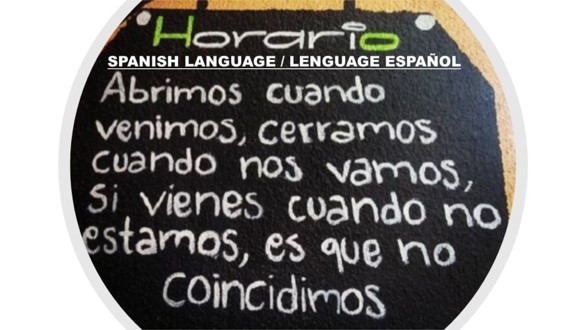
We open when we come,                  On ouvre quand on arrive,
We close when we leave, On ferme quand on part,
If you come when we aren’t here,
Si vous venez quand on n’est pas là,
It’s that we couldn't connect
C est qu’on n’a pu faire connexion

Spanish, a language that surprised me!

I’ve always loved languages. Being French, I’ve studied English, Latin, Italian, and now
Spanish. I hoped to sort it out because Occitan, my grandparents’ language I used to
hear as a child, was also latino. I thought I’d manage, and I did: Hola, mi amigo and all that.
I loved it, no problem.

The first surprise came with some words ending in -a: el problema (as in Italian) but also
el idioma ‘la langue’ and el dia, ‘the day’ were masculine nouns with a feminine ending.
Dia, also used in Occitan, sounded closer to [dio]. The second surprise was to hear Aquellos
to mean ‘those’ in Spanish which reminded me of the Occitan phrase ‘Aquelos Montagnos’ ,
‘these mountains’ from the famous Occitan hymn Se Canto / Se Canta !

I later had daily headaches learning tricky Spanish irregular verbs. I could use puedo to say
‘I can', but the infinitive was poder. Many verbs have had their vowels repeatedly switched
by Spanish speakers over centuries. Spanish irregular verbs worse than in French? That
was impossible. What a reprieve when I found I could say ‘to make possible’ using a
regular verb, imposibilitar.


L’Espagnol, une langue qui m’a surprise

J’ai toujours aimé les langues. Etant Française, j’ai 'étudié l’Anglais, le Latin, l’Italien
et l'Espagnol récemment. J’espérais m’en sortir puisque l’Occitan, la langue que
j’écoutais dans ma jeunesse, parlée par mes grands-parents, était aussi latino. Tout m’a
plu et j’ai bien commencé : Hola, mi amigo et tout ce qui s’ensuit. Pas trop de problème.

Première surprise, des mots qui finissaient en -a comme les mots féminins, el problema
(comme en Italien), el idioma, ‘le langage’ et el dia ‘le jour’ mais ils étaient masculins.
Dia s’approchait de l’Occitan et il se prononçait plus proche de [dio]. La seconde surprise
était d’entendre Aquellos, qui voulait dire ‘ceux-là’ en Espagnol et qui me rappelait la
phrase en Occitan 'Aquelos montagnos, ‘ces montagnes’, du célèbre hymne d’Occitanie
Se Canto / Se Canta.

Un mal de tête journalier se révéla face aux pénibles verbes irréguliers de l’Espagnol.
Je pouvais dire puedo pour ‘Je peux’ mais poder était son infinitif et comme beaucoup
d’autres verbes, il avait subi une inversion de voyelles par des personnes qui parlaient
l’espagnol sans arrêt pendant des siècles. Les verbes irréguliers espagnols seraient-ils
pires que ceux du Français? Impossible! Alors avec quiétude je découvris que pour
dire ‘rendre possible’ il existait un verbe régulier, imposibilitar.

‘Morlana’-Traditional Occitan song from Southern France

Occitan, spoken in Southern France

was my grandparents’ language.

I love to listen to songs revived by Nadau.

Read and Listen

Translated in English and French

https://lyricstranslate.com/fr/morlana-morlanne.html-0
© Nadau

OCCITAN  
© Nadau

Per Sent Laurenç a Morlana,
I avé lua sus los teits,
E la hésta a las platanas,
Qu'arribavi de la nueit.

Morlana cantava,
Jo qu'èri amoros,
Quimèra, engüera,
Lo ser qu'èra tant doç.

Qu'i trobèi ua gojateta,
Asseduda au canton,
Qu'èra din trop tristoneta,
Que sorti l'acordeon.

Que joguèi ua musiqueta
Qui m'avèn cantat los vielhs,
Que vedoi ua estaleta,
Qui se la cado deus uelhs.

Non sèi pas tot de la vita,
Mes que sèi que lo Bon Diu,
Qu'a inventat la musica,
T'à d'aquera larma, aquiu.

Adiu, donc, adiu Morlana,
Qu'as la lua sus los teits,
E la hèsta a las platanas,
Que me'n torni tà la nueit.
ENGLISH
© amsmith

Saint Laurent's Day at Morlana
With the moon on the roofs
The party under plane trees
I emerged from the night

Morlana was singing
I was in love,
Chimera, once more,
The evening was soft

There I found a young girl,
Sitting, afar in the corner,
Looking somewhat cheerless,
So I reached for the accordion.

I played a piece of music,
the same as the elders
used to sing to me,
I saw a star fall from her eyes

I know little of life,
But I know that our God
Did invent this music
So as to make a tear shine

Farewell, farewell Morlana,
The moon is over your roofs,
A party under the plane trees,
I’ll go back into my night.
FRANÇAIS
© Nadau

Pour la St Laurent à Morlanne
Y avait de la lune sur les toits,
Et la fête aux platanes,
Jarrivais de la nuit.

Morlanne chantait,
Jétais amoureux,
Chimère, encore,
Le soir était si doux.

Jy trouvais une jeune fille,
Assise là au coin,
Elle était un peu trop triste,
Jai sorti laccordéon.

Jai joué une musique
Que mavaient chanté les vieux
Jai vu une étoile
Qui est tombée de ses yeux.

Je ne sais pas tout de la vie,
Mais je sais que le Bon Dieu
A inventé la musique
Pour cette étoile là.

Adieu, donc, adieu Morlanne,
Tu as la lune sur les toits,
Et la fête aux platanes,
Je men reviens vers la nuit.

French Chansons / On Chante

Featured
Jacques Brel: Quand on n’a que l’amour.
Leo Ferre: Paris Canaille
Georges Brassens: L’ Auvergnat. Elle est a toi cette chanson


French Chansons / On Chante 

I was supposed to read a book,
Yet couldn’t even read the news
I was better, but still quite weak.
After covid, the damned shingles.

Eyes closed, I played the olden tunes
of my adolescence in France
Some said it must be nostalgia,
I called it French songs on my phone.

Ils chantent eux, moi je fredonne,
et je murmure une mélodie
émettant l’écho du terroir,
qui me parle d’un lointain chez moi.

Piaf et sa Môme lance les chanteurs
dont les paroles, plus que les airs,
sont restées, ancrées dans ma peau.

Aznavour s’y Voyait Déjà,
Mais Jacques Brel n’avait Que l’Amour,
Brassens nous donna Cette Chanson
Jean Ferrat chanta sa Montagne,
Leo Ferré Paris Canaille.

Et moi j’entonne Le Se Canto,
l’hymne occitan de mon pays
Qui est le mien. Well, used to be.


Quand on n’a que l’amour

À s’offrir en partage
Au jour du grand voyage
Qu’est notre grand amour
Quand on n’a que l’amour
Mon amour, toi et moi
Pour qu’éclatent de joie
Chaque heure et chaque jour
 …
Quand on n’a que l’amour
Pour parler aux canons
Et rien qu’une chanson
Pour convaincre un tambour
Alors sans avoir rien
Que la force d’aimer
Nous aurons dans nos mains
Amis le monde entier

Chanson pour l’Auvergnat
 
Elle est à toi cette chanson
Toi l’Auvergnat qui, sans façon
M’as donné quatre bouts de bois
Quand dans ma vie il faisait froid
Toi qui m’as donné du feu quand
Les croquantes et les croquants
Tous les gens bien intentionnés
M’avaient fermé la porte au nez
Ce n’était rien qu’un feu de bois
Mais il m’avait chauffé le corps
Et dans mon âme, il brûle encore
À la manière d’un feu de joie
Toi, l’Auvergnat quand tu mourras
Quand le croque-mort t’emportera
Qu’il te conduise à travers ciel
Au père éternel


Elle est à toi cette chanson
Toi l’étranger qui, sans façon
D’un air malheureux m’as souri
Lorsque les gendarmes m’ont pris
Toi qui n’as pas applaudi quand
Les croquantes et les croquants
Tous les gens bien intentionnés
Riaient de me voir emmené
Ce n’était rien qu’un peu de miel
Mais il m’avait chauffé le corps
Et dans mon âme, il brûle encore
À la manière d’un grand soleil
Toi, l’Étranger quand tu mourras
Quand le croque-mort t’emportera
Qu’il te conduise à travers ciel
Au père éternel

‘Tien te dret’ (Occitan )

Featured

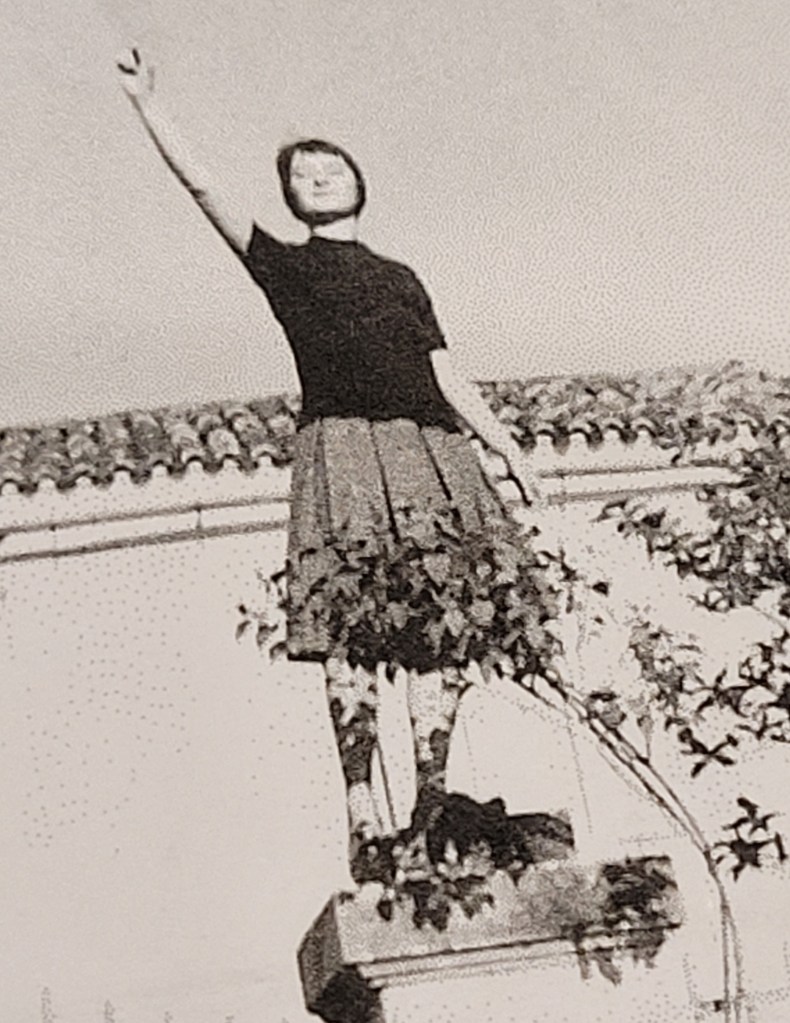
[‘Tien te dret’ in Occitan; photo by M-J. Damy]