Occitan, lenga d'òc, is a Romance language spoken in a third of France across the south also called Occitanie, Italy's Occitan Valleys, and Spain’s Val d'Aran. It is the language of the people who used òc to say ‘yes’. (Northern France used to say 'oïl '.)
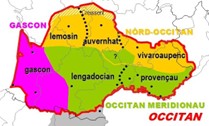
The language of medieval troubadours, it is distinct from French, sharing closer ties to Catalan. It’s an endangered language, with six major dialects: Gascon-Béarn, Provençal-Nice, Languedocien (often used as the basis for the standard form), Limousin - North Dordogne, Auvergnat and Provençal Alpin.
It was my grandparents’ language. Both my parents spoke fluent Occitan-Limousin with their parents in the North Dordogne region of France, also called the ‘Green Périgord ’. I only spoke some phrases of it, but I understood instructions given to me (and had to follow them!) I remember older Occitan songs especially Se Canto. Thanks to Nadau’s compositions, concerts and revival (www.nadau.com) of the Gascon-Béarn language, the tone and vitality of my grandparents and parents' voices are revived. I am now re-learning Occitan online from Australia.
L’Encantada, The Enchanted, is the most famous Occitan (Béarn) song performed by the Nadau Group [ https://nadau.com/ ], which although composed relatively late by Nadau, as the journal Le Point tells us (02.06.2017) is now interpreted as ‘traditional’. Mike Bresson (fb) tells us that L’Encantada is 'a hymn to love, as in love at first sight.’
Follow the Lyrics below:
L’Encantada- chanson de Nadau en Occitan
L'occitan est une langue romane (lenga d'òc) parlée dans le tiers sud de la France, aussi appelée Occitanie, ainsi que dans certaines vallées d'Italie et le Val d'Aran en Espagne. C’est la langue qui utilise òc pour dire 'oui'. Dans le Nord on disait 'oi'.
Connue comme la langue des troubadours du Moyen-Age, elle est différente du Français et très proche du Catalan. C’est une langue en danger, elle se divise en six dialectes définis (Gascon-Béarn, Provençal-Nice, Languedocien (souvent la base d'un standard), Limousin - Nord Dordogne, Auvergnat et Provençal Alpin.
C'était la langue de mes grands-parents en Dordogne du Nord qui s'appelle aussi le Périgord Vert . Mes parents parlaient couramment à leurs parents en Occitan. Je n'en parlais que quelques phrases mais je comprenais bien les instructions qu’on me donnait (et j’étais obligée de les suivre !) Je me souviens des chansons en Occitan surtout Se Canto. Grâce aux compositions et concerts de Nadau (www.nadau.com) et de son relancement du Gascon-Béarnais, je revis le ton et la vitalité de la voix de mes grandparents et parents et je réapprends l’Occitan sur l’internet depuis l'Australie.
L’Encantada est une chanson en Occitan (Béarnais) la plus célèbre du groupe Nadau https://nadau.com/ bien que composée relativement tard, comme nous dit la revue Le Point (02.06.2017), elle est interprétée comme ‘traditionnelle’. Mike Bresson nous dit (fb) « L’Encantada est un hymne à l’amour du genre ‘coup de foudre.»
Paroles ci-dessous :
https://www.nadau.com/paroles/1725#


L'ENCANTADA -Occitan

Patapim,Patapam,
Non sèi d’on ei sortida,
Non m’a pas briga espiat,
E m’èi pergut suu pic,
E la hami e la set.
Patapim, Patapam,


Non sèi çò qui m’arriba,
E shens nada pieitat,
Que’n va lo son camin,
Que camina tot dret.
Non sèi pas lo son nom,
Tà jo qu’ei l’Encantada,
Tà la véder passar,
Jo que’m hiqui ací,
Tot matin a l’argueit,


Non sèi pas lo son nom,
Tà jo qu’ei l’Encantada,
Non hèi pas qu’i pensar
E la nueit e lo dia
E lo dia e la nueit.
Jo tostemps qu’avi sabut
E díser non e díser adiu,


Jo jamei n’avi volut,
Jamei pregar òmi ni Diu,
Ara qu’ei plegat lo jolh,
Dehens la gleisa capbaishat,
Tà mendicar çò qui voi,
Aledar au son costat.


De la tèrra o deu cèu,
Tau com la periclada,

E tot a capvirat,
Arren non serà mei,

Non jamei com avans,
Ni lo hred de la nèu,
Ni lo verd de la prada,

Ni lo cant d’un mainat,
Ni l’anar deu sorelh

Qui hè córrer los ans.
Non sèi pas lo son nom,


Tà jo qu’ei l’Encantada,
E si n’ei pas tà uei,
Tà doman qu’ei segur,
Que l’anirèi parlar,
Non sèi pas lo son nom,
Tà jo qu’ei l’Encantada,
Doman que’u diserèi,
Dinca ací qu’èi viscut
Sonque tà v’encontrar.
https://www.nadau.com/paroles/1725#


L'ENCHANTĖE -Français

Patapim, Patapam,
Je ne sais d’où elle est sortie,
Elle ne m’a même pas regardé,
Et j’ai perdu tout de suite
Et la faim et la soif.
Patapim, Patapam,


Je ne sais ce qui m’arrive,
Et sans aucune pitié,
Elle va son chemin,
Elle chemine tout droit,
Je ne sais pas son nom,
Pour moi, c’est l’Enchantée,
Pour la voir passer,
Moi, je me mets ici,
Tous les matins à la guetter,


Je ne sais pas son nom,
Pour moi, c’est l’Enchantée,
Je ne fais qu’y penser
Et la nuit et le jour
Et le jour et la nuit.
Moi, toujours j’avais su,
Et dire non et dire adieu,


Moi, jamais je n’avais voulu,
Jamais prier homme ni Dieu,
Maintenant j’ai plié le genou,
Dans l’église, la tête baissée,
Pour mendier ce que je veux
Respirer à côté d’elle.


De la terre ou du ciel,
Comme la foudre,

Et tout a chaviré,
Rien ne sera plus,

Non, jamais comme avant,
Ni le froid de la neige
Ni le vert de la prairie

Ni le chant d'un enfant
Ni la marche du soleil

Qui fait courir les années.
Je ne sais pas son nom,


Pour moi, c’est l’Enchantée,
Et si ce n’est pas aujourd’hui,
Demain c’est sûr,
J’irai lui parler,
Je ne sais pas son nom,
Pour moi, c’est l’Enchantée,
Demain je lui dirai,
Je n’ai vécu jusqu’ici
Que pour vous rencontrer
Patapim, patapam I don't know where she came from She never took a glance at me I lost her right away Then came hunger & thirst Patapim, Patapam,
I don't know what's happening to me And without any mercy She walked away She went straight ahead I don't know what's her name For me, she's the Enchanted To see her pass by, I'd put myself there Every morning I 'd watch
I don't know what's her name For me, she's the Enchanted I'd just think about her And all night and all day And all day and all night I 'd always known about her &she said no &said goodbye
I had never wanted to I never prayed to any man or to God Now I am on my knees Inside the church, bowing down To beg for what I want Breathing right next to her
From the earth or the skies It struck like lightning And everything turned over Nothing will be ever like this anymore No never like this before Not even the coldness of snow Not even the greenness of the fields Not even a song of a child Not even the marching of the sun That would run through the years I don't know what's her name
For me, she is the Enchanted And if it's not today Then tomorrow, for sure I'll soon talk to her I don't know what's her name For me, she's the Enchanted Tomorrow, I'll tell her That I have lived long enough Just to meet you





You must be logged in to post a comment.