French Chansons / On Chante

Jacques Brel: Quand on n’a que l’amour.
Leo Ferre: Paris Canaille
Georges Brassens: L’ Auvergnat. Elle est a toi cette chanson


French Chansons / On Chante 

I was supposed to read a book,
Yet couldn’t even read the news
I was better, but still quite weak.
After covid, the damned shingles.

Eyes closed, I played the olden tunes
of my adolescence in France
Some said it must be nostalgia,
I called it French songs on my phone.

Ils chantent eux, moi je fredonne,
et je murmure une mélodie
émettant l’écho du terroir,
qui me parle d’un lointain chez moi.

Piaf et sa Môme lance les chanteurs
dont les paroles, plus que les airs,
sont restées, ancrées dans ma peau.

Aznavour s’y Voyait Déjà,
Mais Jacques Brel n’avait Que l’Amour,
Brassens nous donna Cette Chanson
Jean Ferrat chanta sa Montagne,
Leo Ferré Paris Canaille.

Et moi j’entonne Le Se Canto,
l’hymne occitan de mon pays
Qui est le mien. Well, used to be.


Quand on n’a que l’amour

À s’offrir en partage
Au jour du grand voyage
Qu’est notre grand amour
Quand on n’a que l’amour
Mon amour, toi et moi
Pour qu’éclatent de joie
Chaque heure et chaque jour
 …
Quand on n’a que l’amour
Pour parler aux canons
Et rien qu’une chanson
Pour convaincre un tambour
Alors sans avoir rien
Que la force d’aimer
Nous aurons dans nos mains
Amis le monde entier

Chanson pour l’Auvergnat
 
Elle est à toi cette chanson
Toi l’Auvergnat qui, sans façon
M’as donné quatre bouts de bois
Quand dans ma vie il faisait froid
Toi qui m’as donné du feu quand
Les croquantes et les croquants
Tous les gens bien intentionnés
M’avaient fermé la porte au nez
Ce n’était rien qu’un feu de bois
Mais il m’avait chauffé le corps
Et dans mon âme, il brûle encore
À la manière d’un feu de joie
Toi, l’Auvergnat quand tu mourras
Quand le croque-mort t’emportera
Qu’il te conduise à travers ciel
Au père éternel


Elle est à toi cette chanson
Toi l’étranger qui, sans façon
D’un air malheureux m’as souri
Lorsque les gendarmes m’ont pris
Toi qui n’as pas applaudi quand
Les croquantes et les croquants
Tous les gens bien intentionnés
Riaient de me voir emmené
Ce n’était rien qu’un peu de miel
Mais il m’avait chauffé le corps
Et dans mon âme, il brûle encore
À la manière d’un grand soleil
Toi, l’Étranger quand tu mourras
Quand le croque-mort t’emportera
Qu’il te conduise à travers ciel
Au père éternel

Navigating paths in town on a rainy day

Mindful navigation  in town on a rainy day

I try not to walk on the crack but there are other lines I care not to cross.
Yesterday, it was raining and I was making my way from one side
of the street to a group of shops without crossing anyone’s path.
I also ignored the shine, the sounds and the glistening
that are only there as a magnet.

One glance at people around me and I try and guess some of their
intents. I first walked alongside a mother and her son, who seemed
happy, chatting on their way to the ‘Raisin’ [Ray’s in] café that
people go to because they like its name. Next a woman
in a well-oiled wheelchair smiled at me.
We shared a peaceful look.

I slipped behind her at the time when a youth, in a casual
T-shirt, who appeared in a great rush, disappeared
in the entrance of the store I had targeted.

One extra step took me into its doorway
where a man, with a cap on, stared
at his mobile allowing me time
to close my umbrella.

This pleased me because I had achieved
to reach my favourite store without
disturbing any one’s space.


Navigation consciente, un jour de pluie, en ville

Je tente de ne pas empiéter le chemin des personnes autour de moi.
Hier il pleuvait. J’ai traversé la rue pour aller vers un groupe
de magasins sans croiser personne et en ignorant
le magnétisme des décors étincelants
et des sons bruyants.

D’un coup d’œil sur les gens autour de moi j’essaie de deviner
un peu leurs intentions. J'ai d'abord marché aux côtés
d'une mère et de son fils, qui semblaient heureux
et parlaient d’aller ‘Aux Deux Nids’ [Oh, De-nis]
où les gens viennent prendre un café parce
qu’ils aiment ce nom. Puis une femme
dans un fauteuil roulant bien huilé,
m’a souri et elle a échangé avec
moi un regard serein.

Je me suis glissée derrière elle au moment où un jeune homme
en T-shirt décontracté, qui semblait très pressé, a disparu
dans l'embrasure du magasin vers lequel je me dirigeais.

Un pas de plus m'a conduit à son entrée où un homme
à casquette regardait son portable. Ceci me donna
le temps de fermer mon parapluie.

Quel plaisir pour moi d’avoir réussi
à atteindre mon magasin préféré
sans avoir usurpé l’espace
d’aucun autour de moi.


Spiral, spirit and serenity

Spiral, spirit and serenity

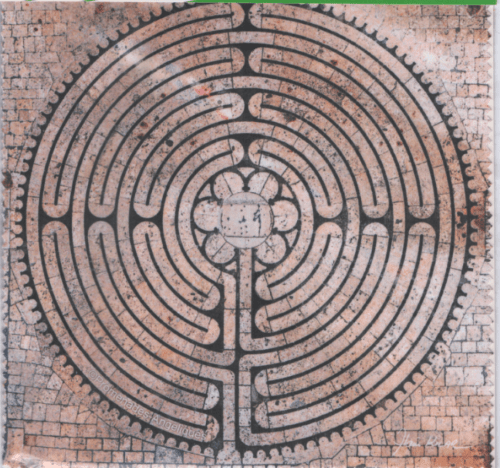
Opening the window, I saw a garden reminding me of labyrinths
its paths drawn towards the interior. Little by little, my eyes
followed the universal curves of nature, and the spiralling
diminished. These meanderings had the effect of me
becoming lighter and I floated past the window.
At the centre of this virtual flight, I saw
what seemed like a sunflower. I took
a photo this exotic garden laying
there in the heart of France.
What an amazing vision
in Chartres! Falling
to my bed, I fell
into a peaceful
serene sleep.


Spirale et esprit de sérénité

En ouvrant ma fenêtre je vis un jardin qui me rappelait un labyrinthe
dont les pistes partaient sur l’intérieur. Petit à petit, mes yeux qui
suivaient ces courbes universelles de la nature virent la spirale
s’atténuer. Tous ces colimaçons eurent l’effet de me rendre
plus légère en me faisant flotter du haut de ma fenêtre.
Au bout de ce vol virtuel je fis face à une fleur
qui ressemblait a un tournesol. Quelle vue
inouïe de ma chambre à Chartres! Je
pris une photo du jardin exotique
situé en plein cœur de France.
Je me retournai vers le lit
et la je fus prise d’un
sommeil pacifique.

‘Tien te dret’ (Occitan )

[‘Tien te dret’ in Occitan; photo by M-J. Damy]

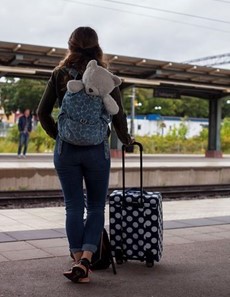
 The first time I leave home (Trilingual)

The first time I leave home
The year is 1955. My mother gives me a black and white suitcase
and gives me bread and salami for the trip. I'm taking the train
to England. It passes through Paris to Le Havre. I put the salami
in my suitcase because I'm not hungry. With my friends and a
teacher we are going to Bristol by night ferry. In Southampton,
we take a dusty old train to Bristol station. I spend a month with
a nice family. But in the evening I feel homesick when I open
my suitcase which smells of salami.

La première fois que je quitte la maison
Nous sommes en 1955. Ma mère m'offre une valise noire et
blanche et me donne du pain et du saucisson pour le voyage.
Je prends le train pour l’Angleterre. Il va au Havre par Paris.
Je range le saucisson dans ma valise car je n’ai pas faim. Avec
mes amies et une professeur nous allons à Bristol par ferry de
nuit. A Southampton, nous prenons un vieux train poussiéreux
pour nous rendre en gare de Bristol. Je passe un mois avec une
famille sympathique. Mais le soir j’ai le mal du pays en ouvrant
ma valise qui sent au saucisson.

La primera vez que salgo de casa
Es el año 1955. Mi madre me regala una maleta blanca y negra
y me da pan y salchichas para el viaje. Voy a tomar el tren
a Inglaterra. Pasa por París y Le Havre. Guardo la salchicha
en mi maleta porque no tengo hambre. Con mis amigos
y una profesora vamos a Bristol en ferry nocturno. En
Southampton, tomamos un viejo tren polvoriento hasta
la estación de Bristol. Paso un mes con una familia agradable.
Pero por la noche siento nostalgia cuando abro mi maleta
que huele a salchicha.

A chant and a poem

Anyone feeling ‘unwell within themselves’

or ‘feeling things are not quite right’,

please contact: 13 YARN

                    A Chant
-
Two ten-year old Australian suicides in WA


***
Ten year-olds are children

Let them talk to their folks

Let their eyes open wide

Let their lips start smiling

Let them walk free of pain

Let them feel how much

We will aways love them.

***
 A Poem [After Prévert]
-
The sad suicide of two
ten-year old Australians

***
They say no with the head
they say yes with a smile
they agree with loved ones
they say no to teachers.
Sitting beside the board,
the problems yet to solve
they burst out in laughter,
and rub off the writings.
Despite the many threats
of staring smart-arses
they draw in full colour
the face of happiness
on the whiteboard

of adversity.
Anyone feeling 
‘unwell within themselves’ or ‘feeling things 
are not quite right’, please contact: 13 YARN 

Requiem for a Voice

by Anne-Marie Smith

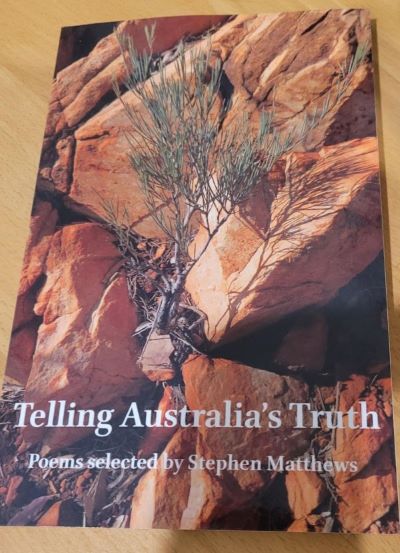
Feel free to contact:Telling Australia’s Truth by Stephen Matthews at:
https://www.ginninderrapress.com.au

 	[D’après François Villon’s Ballade
‘Frères humains qui après nous vivez’, 1489]


Sisters among whom I’ve enjoyed living,
Those of you whose words I have read and heard,
Women who ponder the choices we have,
My daughters (and those later born of them),
Sisters be aware, you are role models
Forget the crude jests and crass abuses
That mocked you and your personal beliefs
The Uluru call was a people’s cry
Own your power and claim: kulila*!
People, be humane: listen to the voice.

Australians, your First Peoples have spoken
Asking for their growth to be supported,
Calls for survival have remained unheard
Can’t we offer them the chance of progress?
Ignore the put-downs rebukes and the likes
Yesterday we closed and maintained silence,
We switched off the news, respecting elders
Let’s be heard again, speak for a fair go!
Grant the First Peoples what they ask: be just!
People, be humane: listen to the voice.

And you good reader, wishing to alleviate
The First People’s needs in healthier days,
You who plan ahead devising programs
For a better life, take a step: be kind!
People, be humane: listen to the voice.

*kulila: means ‘listen!’ in Pitjantjatjara language in the APY lands

Feel free to contact Telling Australia's Truth by Stephen Matthews:
https://www.ginninderrapress.com.au

Success and Failure/Succès et difficultés

Best and Worst features ?

Put things off? I don’t. I move instantly.
I improvise and wing it. I get on well
with people. At a friend’s I tidy up
her magazines by date. I insist
she gets rid of some. Then we
both burst out laughing over
last year’s horoscope
and we have fun.

What’s my worst feature? Telling stories, is one,
I ramble and have no sense of timing when
I share a joke. My abrupt ending comes
too soon and nobody gets it. I may
well get a sympathetic smile,
but there’s a catch: people
aren’t sure what to
make of me.

Qualités ou Défauts ?

Procrastiner ? Pas moi. Je fais tout instantanément.
J’improvise et me lance au hasard. Je m’entends
bien avec les gens. Chez une amie, je me mets
à trier ses magazines dans l’ordre de dates.
J’insiste pour qu’elle en garde moins.
Tout à coup nous éclatons de rire
en lisant les horoscopes de l’an
dernier. C’est très amusant !

Mon plus grand défaut ? J’en ai ! Le pire c’est
quand je raconte des histoires, je me perds
dans l’intrigue et finis si vite que
personne ne comprend rien.
J’ai peut-être droit à un
sourire sympathique,
mais l’ennui c’est
que les gens se
demandent
qui je suis.

A Diamond and a Ball

               
   A poem for dreaming
    

        This

  
is a story

   
I wrote in the shape

of a diamond that I would

  offer in a contest for the icon

of a jewellery store that's running

   next monththe question is

    whether this was worth

   
doing


    Un poème de rêveur


     J’ai

écrit

   ces mots

en forme d'un

   diamant que j'offrirai

en dessin pour un concours

d’enseigne de joailler tres bientot

il reste la question de savoir

     pourquoi j'ai créé
  
   
cela


   A poem for acting


    A short story

   I drew in the shape

  of a ball which I could

kick and send to anyone

  to play or to use in a

   coming event but

    can I use it?


  Un poème pour l'action


Petite histoire  

en forme deballon

que je pourrais envoyer

faire passer à qui le voudrait

pour jouer et participer

à tout évènement

ça vous dirait?

Charlie Chaplin’s tears

Charlie Chaplin’s sad face
                                  Charlie Chaplin's tears

           Charlie Chaplin made people laugh, yet he said
‘I always like walking in the rain so no one can see me 
crying’. I laughed watching him come into the bedroom 
while his wife brandishes a baseball bat. He must have 
cried often enough for this to coincide with rain. 
         Imagine people at home giggling after his films, 
while he saunters outside. He’d wave back to you but 
you wouldn’t see the big tear drop on his jacket that was 
already wet. You 'd walk home a hero and boast ‘Charlie 
Chaplin just waved to me’. Your family 'd keep laughing.
                           Les larmes de Charlie Chaplin

         Charlie Chaplin faisait rire les gens, mais il a dit 
‘J’aime marcher sous la pluie car personne ne peut voir 
mes larmes’. J’ai ri de le voir arriver dans sa chambre 
lorsque sa femme brandissait un grand bâton. Il a du 
pleurer souvent pour que ces pleurs coïncident à la pluie. 
          Imaginez les gens chez eux à rigoler après ses films 
pendant qu’il se promène dehors. Il vous saluerait mais 
vous ne verriez pas cette larme tomber sur sa veste déjà 
mouillée. Vous iriez chez vous fier leur dire ’Charlie 
Chaplin m’a fait bonjour’. Et votre famille continuerait 
à rire.