Introduction (from Part 1) I discuss information I gathered from a book called The Bilingual Brain which highlighted many of my own experiences as a bilingual speaker (French and English). It also confirmed my observations as a parent of two bilingual children. Feel free to read: Albert Costa. The Bilingual Brain. Penguin Books, 2017.
1 Bilingual people can be speakers of two languages regardless - whether they learnt a language from birth - how frequently they speak the language - how proficient they are in that particular language
2 Bilingual Adults as Jugglers
A Juggling - Costa says that bilingual adults are like jugglers. But I suggest their juggling remains invisible. - When bilingual persons (Spanish speakers) talk with English adults, for whom English is the First language, it is rare that they slip into the bilingual’s own language (Spanish) although the bilingual person's brain has not turned off their own language. It is there, though they don’t use it. It remains invisible. - However, it is well known that monolinguals as well as bilinguals can introduce words of another language like in the phrase ‘el check-in’ in a conversation but this is often because these are commonly used phrases internationally.
B Code switching - So, the adult bilinguals juggle but they also switch. In informal situations, like around a table with family and friends, people allow themselves to change to the most relevant speaking style or 'code'. - In our own language, we can all ‘code switch’ using different words, phrases and intonation, in more or less formal circumstances and with people we are more or less familiar with. - That's what we do when we change how we speak at work to a colleague to how we speak to a manager. We 'code switch'. The degree of familiarity and of the environment determine how we speak at home with the family compared to when we talk to a manager or even colleagues in our workplace.
For bilinguals, code-switching happens across two languages when adults feel free to insert a word or phrase of the other language. Bilinguals always follow the grammatical rules of the main language involved.
a ‘Donde están las keys’ (Spanish conversation) [Where are the keys?] Agreement a: the plural verb ‘estan’ agrees with plural noun ‘keys’.
b 'Donde esta la clé?’ (Spanish conversation) [Where is the key?] Agreement b: the singular verb ‘esta’ agrees with singular noun‘key.’
Note : On a personal level, I have surprised myself, saying the following: c ‘Where are my lunettes ?’ (English conversation) [Where are my glasses ?] Agreement c: the plural verb ‘are’ agrees with plural noun ‘lunettes’.
Albert Costa makes the point that when code / language switching, bilinguals follow all the rules of grammar of the dominant language in the conversation.
3 Advantages to brain
A Multitasking - Bilinguals can adjust and code switch in their use of languages, to adapt to their interlocutor and their environment. - Bilingual adults can efficiently classify items under different criteria, and this was seen to also apply to bilingual children [see Part 1]. - Bilinguals showed when tested for attentional capacity that they are better at avoiding conflict and blocking out irrelevant information.
B Better cognitive responses Costa also discusses the lessening of cognitive decline for bilingual Seniors, a theme also covered by a more recent book: Viorica Marian, The Power of Language: Multilingualism, Self, and Society, 2023.
4 Disadvantages of bilingualism
A Lack of speed in some speech circumstances - It may take a little longer for bilinguals to express a thought. - Bilingual children can take slightly longer to start speaking any language, and this should not be of concern to parents.
B More brain effort needed, increasing use of 'the grey matter' - The more dominant the first language, the more the bilingual adults need to block it, and the bigger is the delay or difficulty for them to speak another language. - That is not simply because they cannot remember a word, but because the stronger language keeps interfering. To control this, the brain needs to exercise extra vigour. - Costa says if bilinguals learn other languages, they juggle three or more balls. (This must mean the brain has to work more to exercise this control.)
Conclusion: In conclusion, I refer you again to Viorica Marian for a quotation: ‘Bilingual children as young as seven months can better adjust to environmental changes, while bilingual seniors can experience less cognitive decline.’ Viorica Marian & Anthony Shook, National Institute of Health in the US, 2012.
Adultes bilingues : le bienfait de jongler avec les langues

Adultes (Part 2) [Enfants : voir Part 1, 18Nov25]
Adultes bilingues : le bienfait de jongler avec les langues
Introduction (comme Part 1) : Je discute le livre 'Le Cerveau Bilingue' qui m’a impressionné car il démontrait des expériences qui me sont habituelles en tant que bilingue moi-même (Français & Anglais). La section sur les enfants m’a rappelé des observations de mes deux enfants bilingues. N’hésitez pas à lire : Albert Costa. The Bilingual Brain. Penguin Books, 2017.
1 On est bilingue lorsqu’on est une personne - qui apprend deux langues à la naissance ; - qui parle fréquemment une langue qu’on a étudié ; - qui parle à son propre niveau de compétence dans cette langue.
2 Les adultes bilingues sont comme des jongleurs A Jongleurs - Costa dit que les adultes bilingues sont comme des jongleurs, mais je pense qu’en fait ils jonglent de façon invisible. - Lorsque des adultes bilingues (de langue Espagnol) s’adressent à des adultes pour qui l’Anglais est la Première langue, il est rare qu’ils se mettent à parler avec des mots de leur langue d’origine, bien que leur cerveau n’ait pas éteint leur langue (Espagnol). Elle est là et pourtant ils ne l’utilisent pas. Elle reste invisible. - Cependant nous savons que nous tous, que l'on soit monolingue ou bilingue puisse de temps en temps introduire des mots ou des phrases d’une autre langue comme ‘el-check-in' ou ‘le check-in’, car ce sont des expressions couramment utilisées de façon internationale.
B Alternance de code dans la même langue - Les adultes bilingues jonglent donc avec les langues, mais ils peuvent aussi 'alterner ou changer les codes linguistiques'. - Ce ‘changement de code’ se produit dans les situations informelles, autour d'une table, en famille ou entre amis : chacun choisit un mode de communication adéquate. - Nous faisons tous ainsi dans notre propre langue. Nous changeons de mots, de phrases et d’intonation selon la personne avec qui nous parlons. Le degré de familiarité dépend de notre interlocuteur (ou aussi de l'environnement), que ce soit un directeur, des collègues ou un membre de notre famille. - Chez les personnes bilingues, cette alternance de code/langue se produit lorsque les adultes se sentent libres d'insérer un mot ou une expression de l'autre langue. Les bilingues respectent toujours les conventions de la langue principale utilisée dans la conversation.
a : ‘Donde están las keys’ Conversation en Espagnol [Où sont les clés ?] Accord a: le verbe pluriel ‘estan’ s’accorde avec le nom pluriel ‘keys’.
b: ‘Donde esta la key?’ Conversation en Espagnol [Où est la clé ?] Accord b: le verbe singulier ‘esta’ s’accorde avec le non singulier ‘key’.
Note : Je me surprends souvent à faire ça moi-même, quand je parle ainsi: c : ‘Where are my lunettes ?’ Conversation en Anglais [Où sont mes lunettes ?] Accord c: le verbe pluriel ‘sont’ s’accorde avec la phrase plurielle 'lunettes’.
Costa remarque que l’accord grammatical est toujours maintenu avec la langue dominante de la conversation.
3 Avantages pour le cerveau bilingue
A Tâches multiples et simultanées - Les adultes bilingues peuvent changer de code linguistique pour s’adapter à leur interlocuteur et leur environnement. - Les bilingues peuvent avec efficacité classifier des objets d’après des critères différents, ce qui s’appliquait aux enfants bilingues [voir : première partie]. - Les adultes bilingues ont montré, lorsqu’ils ont été testés pour leur capacité attentionnelle, qu’ils pouvaient éviter certains conflits, en bloquant des détails non-pertinents.
B Moins de diminution de Réponses Cognitives Costa discute aussi le déclin des réponses cognitives chez les ‘Seniors’. Ce thème est couvert dans un livre plus récent : Viorica Marian The Power of Language: Multilingualism, Self, and Society, 2023.
4 Désavantages du bilinguisme
A Moins de rapidité d’expression dans certaines situations - Les adultes bilingues mettent quelquefois plus longtemps pour exprimer leurs pensées. - Les enfants bilingues peuvent mettre un peu plus longtemps à commencer à parler. Ceci ne devrait pas inquiéter les parents.
B Plus d’effort nécessaire qui affecte 'la matière grise' - Plus la langue maternelle est dominante, plus les adultes bilingues ont besoin de la bloquer, donc plus long sera le délai ou la difficulté pour eux de parler dans une autre langue. - Ce n’est pas simplement qu’on ne se rappelle pas un mot, mais c'est dû à l’interférence de langue la plus forte. Pour contrôler cela, le cerveau a besoin de travailler avec vigueur. - Costa nous dit que lorsque les adultes bilingues apprennent de nouvelles langues, ils jonglent avec trois balles ou plus (ce qui veut dire qu’ils doivent travailler encore plus fort ! )
Conclusion : Pour conclure je fais de nouveau une référence à Viorica Marian avec cette citation : ‘Les enfants bilingues dès l’âge de sept mois savent mieux s’adapter aux changements de leurs environnements, tandis que les adultes bilingues et seniorspeuventexpérimentermoins de déclin cognitif.’ Viorica Marian & Anthony Shook, National Institute of Health in the US, 2012
I want to talk of a two-wheel transport method, but it’s not the bicycle behind which my father used to scream ‘Look ahead of you’ but the vehicle I’ve loved for most of my life, the Vélosolex (which, I regret, doesn’t exist anymore in France).
Warning: Do not be confused by imitations.
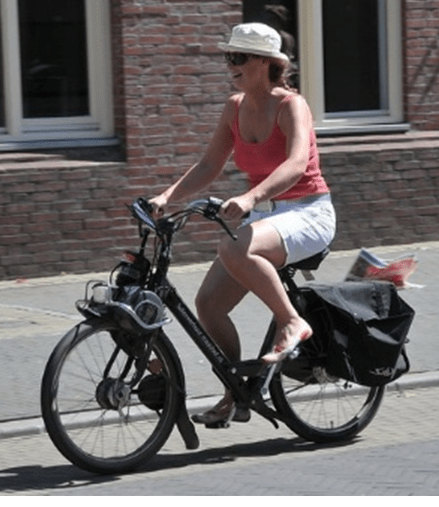
A How to ride a Vélosolex: 1 Note the motor is over the front wheel behind the handlebar. 2a Sit and ride the solex like a bike, then press the black vertical stick gently onto the motor to make it start. 2b Or run alongside the bicycle releasing the black vertical stick on to the front wheel and jump fast onto the saddle. (Warning: that is not a safe technique, you could fall). 3 Once you hold on to the handlebar there is no accelerator as in motorbikes, cars or some bicycles, so you accelerate by pressing on with the right handlebar, depending on whether you want to or not.
B Advantages of the Vélosolex: 1 You are neither as slow nor as fast as other two wheelers, you’ll find your own rhythm. 2 You are not a motor cyclist either who revs past people outside shops or café customers on street pavements to make noise or contaminate the atmosphere. 3 You can go up parallel to a queue of vehicles. Watch out that no one opens their car doors. 4 Thanks to your solex, you can attend your university lectures on time.
Le Vélosolex, une icône de France
Je veux parler d’un mode de transport à deux roues, mais ce n’est pas la petite bicyclette derrière laquelle mon père criait ‘Regarde devant toi’ mais le véhicule que j’ai le plus aimé toute ma vie, le Vélosolex (qui, je regrette, n’existe plus).
Attention : Ne vous laissez pas tromper par des imitations.
A Comment rouler en Vélosolex : 1 D’abord trouver le moteur au-dessus de la roue avant, derrière le guidon. 2a S’asseoir sur le solex comme à vélo et pousser le bâtant noir du moteur légèrement sur la roue avant. Le moteur se branchera. 2b Ou partir en courant le long du solex, pousser le bâtant noir du moteur à la main, et monter très vite sur la selle. (Attention : cette méthode est dangereuse, vous pouvez tomber). 3 Quand on tient le guidon, il n’y a pas de levier de vitesse comme sur les motos, voitures ou même certains vélos, donc on accélère en appuyant avec la manette de la main droite, si on le veut.
B Les avantages du Vélosolex : 1 On n’est ni aussi lent ni aussi rapide que les cyclistes, on trouve son rythme soi-même. 2 On n’est pas non plus un motard qui change de vitesse, en dépassant les magasins et les gens au café, sur le bord de la rue pour faire du bruit et contaminer l’atmosphère. 3 On peut, s’il y a une file de voitures remonter parallèle à tous les véhicules. Attention qu’elles n’ouvrent pas leurs portières ! 4 Grace à votre solex vous pouvez arriver à l’université pour vos cours à l' heure.
A la Française - Of  baguettes and recipe (poached eggs in tomato)

    I want to tell you of my way of doing things, à-la-Française.

1.	Lists : I love to make lists which I number.
2.	Ink Pens : I love to write with  fountain pens  by hand, but when
          typing, I like to use Baguet Script. Try it.
3.     Baguettes : I take pleasure in eating on my way home the end of the
          baguette (it’s called le bout)  that I buy at bakeries. My family
          doesn’t  appreciate.
   4.	Café au lait : I enjoy soaking my bread in my café-au-lait, which is
          not well-mannered . I tell my family  ‘Only if you’re French can
          you do this!’
5.	Gants de toilette : In the bathroom I use glove-shaped facecloths.  I
          detest the squares you find in English or Australian  bathrooms,
          they look like dishcloths.
6.	Poached Eggs in tomatoes. (I give you my favourite recipe)
           -   Find tomatoes at home, or pick some from your garden
           -   Cut two or three peeled tomatoes into small slices
           -   Heat olive oil (or butter) and sliced  garlic in an ordinary frypan
	   -   Place tomatoes in the frypan  before the garlic browns.
           -   When the tomatoes start bubbling gently, break two eggs over
                 them
           -   It’s up to you to place a lid or not, because the eggs will be
                 covered  by the tomatoes’ juice and therefore poached
           -   Serve with baguette which you soak in the eggs and tomatoes
                 or serve on sliced bread which soak in the egg and tomato
7.	Bon appétit !


A la Française - Baguettes et Recette  (œufs pochés à la tomate )

 Je veux vous parler  de choses que j’aime faire, à la Française.

1.	Listes : J’adore  faire des listes et surtout les numéroter
2.	Stylo à encre : J’adore écrire au stylo encre à la main. Quand je tape
          à la machine,  j’aime le Baguet Script.  Essayez -le!
3.	Baguette : J’ai du plaisir à manger le bout de la baguette que j’achète
          à la boulangerie. Ma famille n’aime pas ça, bien sûr
4.	Café au lait :  J’aime tremper mon pain dans mon café au lait, ce qui
           n’est pas correct. Je dis ‘Vous ne pouvez tremper que si vous êtes
           Française'
5.     Gants de toilette : Dans la salle de bains, je me sers de gants de
          toilette car je déteste les tissus carrés qu’on trouve en salle de bains
           anglaises  ou australiennes car ils ressemblent à des torchons
 6.    Œufs pochés à la tomate.  (Je vous donne ma recette préférée).
       -   Prenez vos tomates de la maison ou mieux encore cueillez-les
               dans votre jardin
       -   Coupez deux ou trois tomates épluchées en tranche.
       -   Faites chauffer de l’huile d’olive (ou du beurre) avec de l’ail
               épluché dans une poêle.
       -   Avant que l’ail ne roussisse, placez les tomates dans la poêle.
       -   Quand les tomates bouillonnent légèrement dans la poêle cassez
              deux  œufs dessus.
       -   A vous de choisir si vous mettez un couvercle ou non, car les œufs
              seront recouverts par le jus de tomate, donc pochés.
       -   Servez avec une baguette que vous trempez dans la sauce tomate
              ou servez sur une tranche de pays pour absorber le bon goût.
 7.    Bon appétit !






 Yayi's Paroles
You must be logged in to post a comment.