

The ‘Se Canto/Se Canta‘ is a hymn in the Occitan language which
is used in the majority of Southern France.
This traditional song was written in the 14th century probably
by Gaston Phébus, Comte de Foix et Seigneur du Béarn. It
became popular and is used, with minor variants, across most
of Southern France as a regional hymn. It is sung in the Béarn
and Gascony areas by Nadau, who has also brought to life many
other songs in Occitan. He performed this at the Olympia in 2000.
Below is the version my grandparents would sing in the 1950s, in the
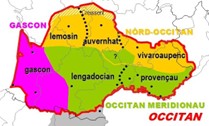
Dordogne. It’s sung in the Limousin to Toulouse, further East to the region
of Provence and South to the Pyrénées.
OCCITAN
Dejós ma fenèstra,
I a un aucelon, Tota la nueit canta,
Canta sa cançon
Chorus
Se canta, que cante,
Canta pas per ieu,
Canta per ma mia,
Qu’es al luènh de ieu.
Aquelas montanhas,
Que tan nautas son,
M’empachan de veire,
Mas amors ont son.
Baissatz-vos, montanhas,
Planas, auçatz-vos,
Per que pòsca veire,
Mas amors ont son.
Aquelas montanhas,
Tant s’abaissaràn,
Que mas amoretas,
Se raprocharàn.
ENGLISH
Outside my window,
There is a little bird
It sings all night
It sings its song
Chorus
If it sings, let it sing,
It’s not singing for me,
It sings for my love
Who’s far away from me
Those mountains
That are so high
Keep me from seeing
Where are my love.
Lay down, o mountains,
Rise up, o plains,
So I may see
Where are my love
Those mountains
Will lay down so low
That my dear love
Will come closer.
FRANÇAIS
Sous ma fenêtre
Il y a un petit oiseau,
Qui toute la nuit chante,
Chante sa chanson.
Refrain
S’il chante, qu’il chante,
Il ne chante pas pour moi,
Il chante pour ma mie,
Qui est loin de moi.
Ces montagnes,
Qui sont si hautes,
M’empêchent de voir,
Où sont mes amours.
Abaissez-vous, montagnes,
Plaines, haussez-vous,
Pour que je puisse voir,
Où sont mes amours.
Ces montagnes,
Se rabaisseront,
Et mes amourettes,
Se rapprocheront.


 Yayi's Paroles
You must be logged in to post a comment.