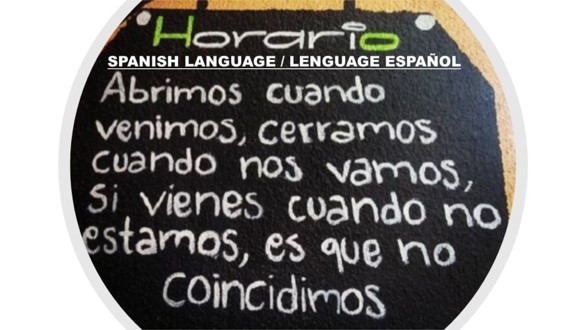
We open when we come,                  On ouvre quand on arrive,
We close when we leave,                   On ferme quand on part,
If you come when we aren’t here,     Si vous venez quand on n’est pas là,
It’s that we couldn't connect             C est qu’on n’a pu faire connexion
Spanish, a language that surprised me!

I’ve always loved languages. Being French, I’ve studied English, Latin, Italian, and now
Spanish. I hoped to sort it out because Occitan, my grandparents’ language I used to
hear as a child, was also latino. I thought I’d manage, and I did: Hola, mi amigo and all that.
I loved it, no problem.

The first surprise came with  some words ending in -a: el problema (as in Italian) but also
el idioma  ‘la langue’ and el dia, ‘the day’ were masculine nouns with a feminine ending.
Dia, also used in Occitan, sounded closer to [dio]. The second surprise was to hear Aquellos
to mean ‘those’ in Spanish which reminded me of the Occitan phrase ‘Aquelos Montagnos’ ,
‘these mountains’  from the famous Occitan hymn Se Canto / Se Canta !

I later had daily headaches learning tricky Spanish irregular verbs. I could use puedo to say
‘I can', but the infinitive was poder. Many verbs have had their vowels repeatedly switched
by Spanish speakers over centuries. Spanish irregular verbs worse than in French?  That
was impossible.  What a reprieve when I found I could say ‘to make possible’ using a
regular verb, imposibilitar.


L’Espagnol, une langue qui m’a surprise

J’ai toujours aimé les langues.  Etant Française, j’ai 'étudié l’Anglais, le Latin, l’Italien
et l'Espagnol récemment. J’espérais m’en sortir puisque l’Occitan, la langue que
j’écoutais dans ma jeunesse, parlée par mes grands-parents, était aussi  latino. Tout m’a
plu et j’ai bien commencé : Hola, mi amigo et tout ce qui s’ensuit. Pas trop de problème.

Première surprise, des mots qui finissaient en -a comme les mots féminins, el problema
(comme en Italien), el idioma, ‘le langage’ et el dia ‘le jour’ mais ils étaient masculins.
Dia s’approchait de l’Occitan et il se prononçait plus proche de [dio]. La seconde surprise
était d’entendre Aquellos, qui voulait dire ‘ceux-là’ en Espagnol et qui  me rappelait la
phrase en Occitan 'Aquelos montagnos, ‘ces montagnes’, du célèbre hymne d’Occitanie
Se Canto / Se Canta.

Un mal de tête journalier se révéla face aux pénibles verbes irréguliers de l’Espagnol.
Je pouvais dire puedo  pour ‘Je peux’ mais poder était son infinitif et comme beaucoup
d’autres verbes, il avait subi une inversion de voyelles par des personnes qui parlaient
l’espagnol sans arrêt pendant des siècles. Les verbes irréguliers espagnols seraient-ils
pires que ceux du Français? Impossible!  Alors avec quiétude je découvris que pour
dire ‘rendre possible’ il existait un verbe régulier, imposibilitar.





















 Yayi's Paroles
You must be logged in to post a comment.